
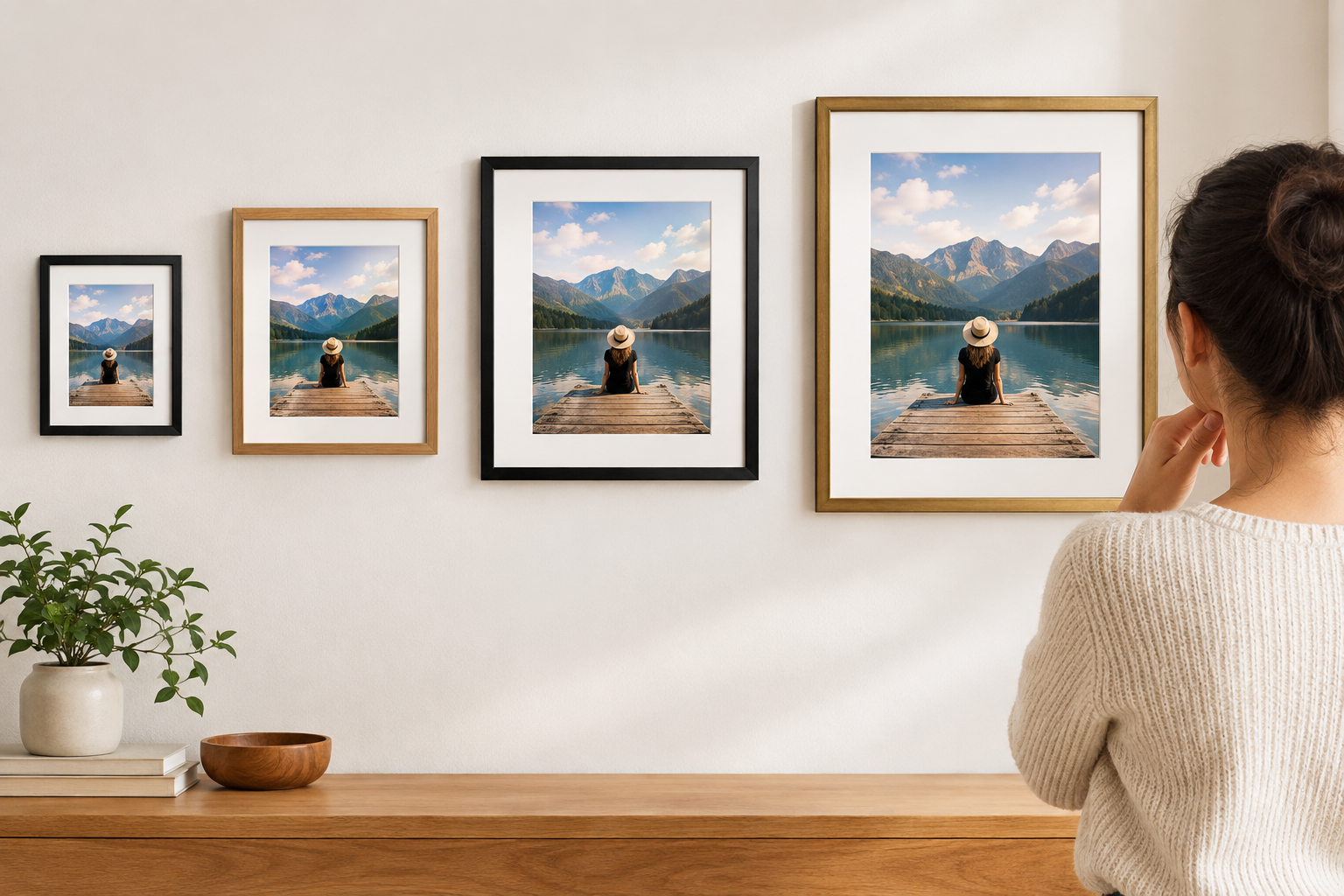
For most everyday photos, 4x6 or 5x7 inches suits a desk or shelf, 8x10 is the most popular all-purpose size for walls and gifts, and 11x14 or 16x20 works for a larger statement piece. If your photo is a phone screenshot or heavily cropped image, check it isn't stretched beyond roughly 200 pixels per inch at your chosen size, since that affects sharpness more than the frame itself. Custom framing and online photo framing in Dubai can size a frame to any of these standard dimensions, or to your photo's exact size if it doesn't match a standard ratio.
Somewhere between "I love this photo" and "I should frame this photo" sits a surprisingly confusing question: what size do I even order? 4x6 and 5x7 sound almost the same until you're standing in front of a checkout screen with no idea which one your phone photo actually needs.
This isn't about professional composition rules or camera specs — it's the plain, practical version of the question, for anyone framing a phone photo, a holiday snapshot, or a printed memory that's been sitting in a drawer. Here's how to actually answer it.
Standard Photo Sizes Explained (Inches and Centimetres)
If you've ever wondered what these size labels actually mean in real terms, here's the full picture:
|
Size (inches) |
Size (cm) |
Common Use |
|
4x6 |
10 x 15 |
Standard print size, desks, small albums |
|
5x7 |
13 x 18 |
Slightly larger prints, shelves, gifts |
|
8x10 |
20 x 25 |
The most popular all-purpose wall size |
|
11x14 |
28 x 36 |
Statement pieces, portrait displays |
|
16x20 |
40 x 50 |
Living room walls, larger family portraits |
|
A4 |
21 x 29.7 |
Standard document/print size, posters |
|
A3 |
29.7 x 42 |
Larger prints and posters |
Photo frames sold in the UAE often list both measurement systems, so knowing this conversion at a glance saves a lot of second-guessing at checkout.
Three Quick Questions to Find Your Size
If the table above still leaves you between two sizes, these three questions usually settle it:
Q1. Where is it going?
• Desk or shelf → 4x6 or 5x7
• Bedroom or hallway wall → 8x10 or 11x14
• Living room or main wall → 16x20 or larger
Q2. Is it a single photo or part of a set?
• Single photo → size for the specific spot it's going
• Part of a gallery wall or collage → keep sizes consistent across the group, or use one collage frame instead
Q3. Was it taken on a phone or a proper camera?
• Phone photo → check resolution before sizing up past 8x10 (see next section)
• Camera photo → most standard sizes will hold up well even at 16x20 or larger
Sizing Phone Photos Specifically
Phone photos deserve their own section because they behave differently from camera photos once you try to print them large. A few things worth knowing:
• Most modern phone photos handle up to roughly 8x10 or 11x14 comfortably without visible quality loss
• Screenshots and heavily cropped or zoomed photos have a much lower effective resolution — check before ordering a large print
• Instagram and social media exports (often square or 4:5 ratio) rarely match standard frame ratios, so custom sizing avoids an awkward crop
• WhatsApp-compressed photos lose quality significantly — always print from the original camera roll file, not a forwarded copy, if possible
When in doubt, a simple test: zoom into the photo on your phone to roughly the size you want to print it. If it looks sharp at that zoom level, it will likely print well at that size too.
When to Size Up, and When to Hold Back
• Size up when the photo is high-resolution, taken with intention, and destined for a prominent wall
• Hold back when the source is a screenshot, an old scanned photo, or a heavily cropped image
• Size up when framing as a gift for a significant occasion — a slightly larger size often reads as more considered
• Hold back when you're framing several photos together, where consistent modest sizing looks more cohesive than one oversized outlier
Don't Forget: Matting Changes the Math
A frame size and a photo size aren't always the same number, and this trips people up more than almost anything else on this list. An 8x10 frame with a wide mat border might only display a 5x7 photo at its centre — which is often exactly what you want for a polished, gallery-style look, but it means checking whether a listed "frame size" refers to the outer frame or the visible photo opening before you order.
• No mat — the frame size and photo size are the same
• Standard mat border — typically adds 1 to 2 inches of visible white space around the photo on each side
• Wide gallery mat — can add 3 inches or more, making an 8x10 photo sit inside a frame that measures closer to 14x16 overall
If wall space is tight, factor the mat into your measurement — not just the photo itself.
Sizing for Gifts vs. Sizing for Your Own Wall
Framing a photo as a gift comes with slightly different sizing logic than framing one for your own home. You don't know the recipient's wall space or decor, so a moderate, universally practical size tends to work better than guessing at something large and statement-sized.
• Safe gifting sizes — 5x7 and 8x10 fit comfortably on a desk, shelf, or small wall in almost any home
• Avoid oversized gifts unless you know the space — a 20x24 piece assumes wall space the recipient may not have
• For a milestone gift (wedding, new baby), a slightly larger 11x14 reads as more considered without becoming impractical
What If Your Photo Doesn't Match a Standard Size?
Not every photo fits neatly into 4x6 or 8x10 — panoramic shots, square Instagram exports, and oddly cropped images all fall outside standard ratios. Forcing one of these into the nearest standard frame usually means cropping part of the image or living with uneven white space on either side.
Custom framing solves this directly: instead of choosing the closest standard size, you enter your photo's actual dimensions and the frame is built around it. Online custom framing in Dubai typically makes this a simple measurement entry at checkout rather than a special request.
1. Check your photo's dimensions or aspect ratio before ordering
2. Compare against the standard size table above to see if it's a close match
3. If it isn't, use custom sizing to match your photo exactly rather than cropping to fit
4. Choose your frame material, matting, and glazing
5. Order your online photo frames for delivery across Dubai and the UAE
Frequently Asked Questions
What is the most common photo frame size?
8x10 inches (20x25 cm) is generally the most popular all-purpose size, versatile enough for desks, walls, and gifts. 4x6 and 5x7 are the next most common for smaller displays.
Can I print a phone photo in a large frame size?
Most modern phone photos handle up to 8x10 or 11x14 well. Beyond that, check the photo isn't a screenshot or heavily cropped, since those lose sharpness at larger print sizes.
What size frame should I use for a single photo on a shelf?
4x6 or 5x7 inches works best for desks and shelves — large enough to see clearly up close, without overwhelming a small surface.
How do I frame a photo that doesn't match a standard size?
Use custom framing sized to your photo's exact dimensions rather than forcing it into the nearest standard frame, which usually means cropping the image or leaving uneven white space.
Does online photo framing in Dubai offer both inches and centimetre sizing?
Yes. Most online photo framing services list standard sizes in both inches and centimetres, and allow custom sizing in either unit if your photo doesn't match a standard size.
The right frame size for your photo comes down to where it's going, how it was taken, and whether it matches a standard ratio at all. When it doesn't, custom framing settles the question without any cropping compromise — and online photo framing makes ordering that exact size as simple as entering two numbers.