
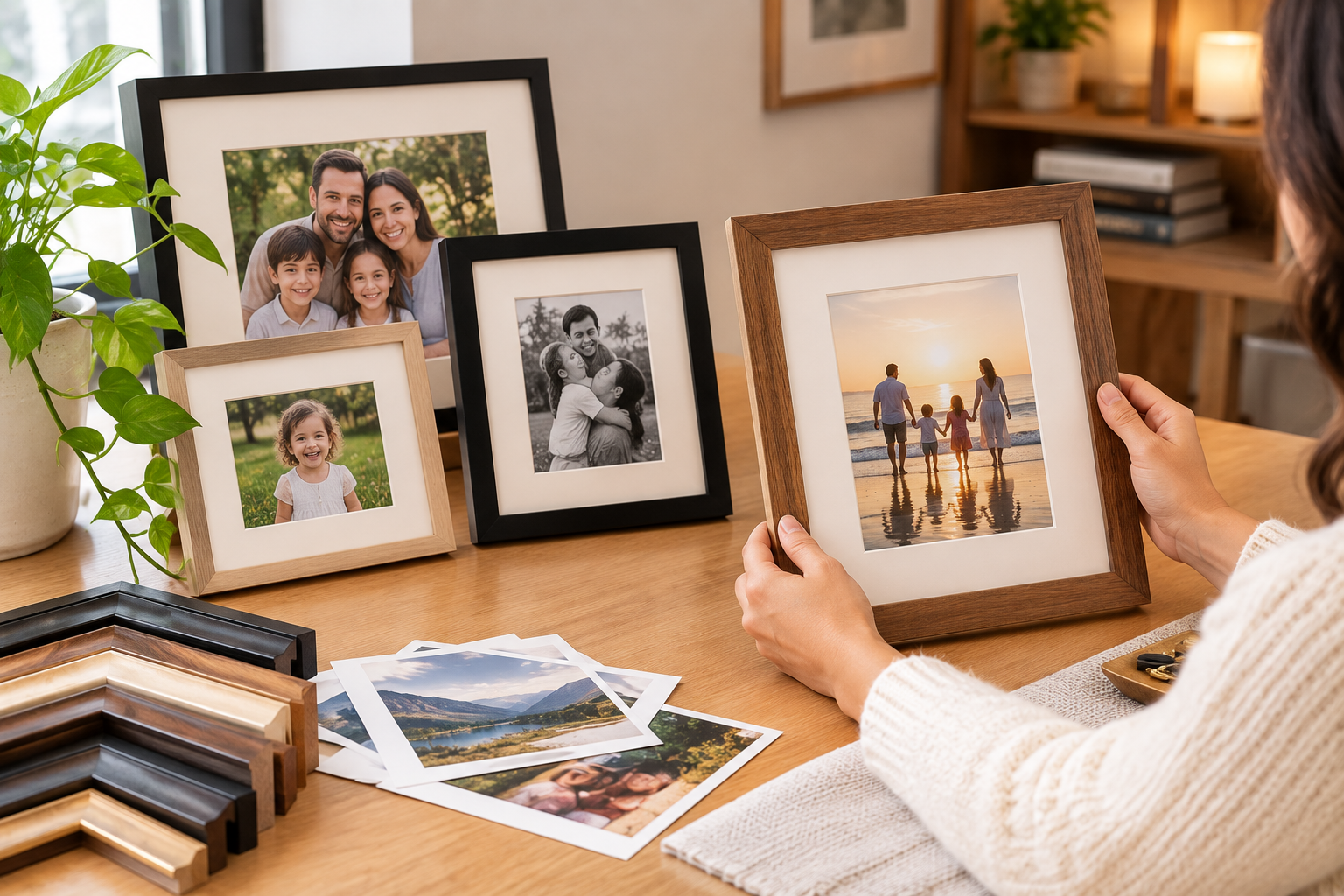
The best way to frame family photos is to match the display style to the room: a curated hero shot or small collage for the entryway, a timeline-style staircase gallery for photos spanning years, a large statement family portrait for the living room, and simple, consistent-style photo frames for hallways and bedrooms. Using custom framing for odd-sized or panoramic family shots, and online photo framing in Dubai for ordering multiple matching frames at once, makes it far easier to turn a scattered photo collection into a cohesive display.
Family photos are the one category almost nobody frames all at once. They accumulate — a hospital photo here, a first-day-of-school shot there, a beach holiday a few years later — until there's a drawer or a camera roll holding a decade of moments that never quite made it to a wall.
The best way to frame family photos isn't one single frame or one perfect layout. It's a plan for where different kinds of family moments actually belong in your home, so the photos you already have find their way onto the wall instead of staying in storage.
Start With Where, Not What
Most people start by picking a frame style, then hunting for wall space to fit it. Working the other way — starting with the room — makes the whole process faster and the result more cohesive, because each space in a home naturally suits a different kind of family photo display.
A Room-by-Room Guide to Framing Family Photos
The Entryway
Best approach: A small, curated cluster of 3 to 5 frames — a recent family portrait plus one or two favourites — sets a warm tone the moment anyone walks in.
Tip: Keep this collection recent and rotate it occasionally; entryways work best as a living, current snapshot rather than a full family history.
The Staircase
Best approach: A timeline-style gallery wall, photos arranged chronologically as they step up alongside the stairs, works exceptionally well here and nowhere else in the home quite as naturally.
Tip: Keep matting and frame style consistent across the whole run so the eye reads it as one continuous story, not a mismatched collection.
The Living Room
Best approach: One large statement piece — a favourite family portrait or a meaningful holiday shot — anchors the main gathering space better than a cluster of smaller frames competing for attention.
Tip: Size the piece to the wall using a viewing-distance rule: bigger and further back for open living rooms, smaller and closer for cosier spaces.
The Hallway
Best approach: A grid layout of same-size, same-style photo frames creates a clean, gallery-like rhythm that suits a hallway's linear shape.
Tip: Uniform frame colour and consistent spacing (5–8 cm) matter more here than in any other room, since hallways are viewed in passing rather than head-on.
The Bedroom or Nursery
Best approach: Softer, smaller-scale framing — a few intimate photos near a bed or crib — suits the room's quieter, more personal purpose.
Tip: Choose gentler frame tones (light wood, cream mats) over bold or dark finishes, which can feel out of place in a room meant for rest.
Layout Styles Worth Knowing
|
Layout Style |
Best For |
Frame Approach |
|
Grid |
Hallways, uniform photo sets |
Identical frame size and colour throughout |
|
Timeline |
Staircases, milestone photos over years |
Consistent style, chronological order |
|
Single hero |
Living rooms, main gathering spaces |
One large statement frame |
|
Curated cluster |
Entryways, shelves |
3–5 mixed sizes, one unifying colour tone |
|
Collage frame |
Multiple related photos in one piece |
Single custom-built multi-opening frame |
Framing Photos That Don't Match
Real family photo collections are rarely uniform — a professional portrait sits next to a phone snapshot from a birthday party, a black-and-white photo from years ago next to something shot yesterday. A few ways to make that variety feel intentional rather than mismatched:
• Pick one consistent frame colour or material across a whole wall, even if the photos themselves vary widely in style
• Convert a mixed set to black-and-white or a consistent colour grade before printing, for a cohesive look across different photo sources
• Use collage frames to group several smaller or lower-resolution phone photos into one piece, rather than framing each individually
• Reserve your largest, highest-quality frame for the sharpest, highest-resolution image in the set
Framing for the Long Term, Not Just This Year
Family photos tend to stay up longer than almost anything else in a home — a nursery photo can still be on the wall a decade later. That makes a couple of small upgrades worth the modest extra cost: acid-free matting to prevent yellowing over the years, and UV-protective glazing for anything catching natural light, especially in a bright climate like Dubai. Neither adds much to the price, and both are the difference between a photo that still looks fresh at year ten and one that's visibly faded.
Making Room for New Photos as the Family Grows
A family photo wall isn't a one-time project — it's a display that needs room to grow. A few small planning choices now save a full rehang later:
• Leave a little extra wall space around a staircase timeline or gallery grid for photos that haven't happened yet
• Choose a frame style and colour you're happy to keep buying for years, rather than a one-off trend piece
• Consider a rotating cluster near an entryway or shelf that swaps in new favourites each year, alongside a more permanent timeline elsewhere
• Keep a simple record of frame sizes and finishes used, so reordering a matching frame later is a quick, exact match rather than a guess
None of this needs to be decided perfectly on day one — it just helps to hang the first few pieces with room, literally and stylistically, for what comes next.
How Online Photo Framing Makes This Easier for Families
A full-home photo display rarely comes together in one trip to a shop — it's usually several different sizes, several different rooms, and photos that keep arriving as the family grows. Online photo framing in Dubai handles this naturally: order a staircase timeline set in one go, add a nursery frame a few months later, and each order uses the same custom framing process without needing to match swatches in person each time.
1. Sort your photos by the room they'll go in, not just by date
2. Choose one consistent frame style per room, or per layout (grid, timeline, cluster)
3. Use custom framing sizing for panoramic, square, or oddly-cropped family shots
4. Add archival matting and UV glazing for pieces you plan to keep up long-term
5. Order online framing in batches as each room comes together, rather than all at once
Frequently Asked Questions
What's the best layout for displaying family photos on a staircase?
A chronological, timeline-style gallery wall works best for staircases, with consistent frame style and matting throughout so the photos read as one continuous story as you walk up.
How do I frame family photos that don't match in style or quality?
Keep the frame colour and material consistent across the display, even when the photos themselves vary. Converting mismatched shots to a consistent colour grade, or grouping smaller ones into a collage frame, also helps unify the set.
Should family photos have matting or UV-protective glass?
Both are worth it for photos you intend to keep up long-term. Acid-free matting prevents yellowing, and UV-protective glazing prevents fading, particularly in bright, sun-heavy climates like Dubai.
Can I order multiple photo frames online in Dubai without visiting a shop?
Yes. Online photo framing lets you order several custom-sized frames for a full gallery wall or staircase display in one go, with consistent sizing and finish across the whole set.
What size frame works best for a family portrait in the living room?
For most living rooms, 16x20 to 20x24 inches works well as a single statement piece, scaling up for larger rooms or further viewing distances.
The best way to frame family photos isn't a single formula — it's matching the display to the room and being consistent within each space. Start with where a photo belongs in your home, choose custom framing sizing when a shot doesn't fit a standard size, and let online photo framing handle the rest as your collection keeps growing.