
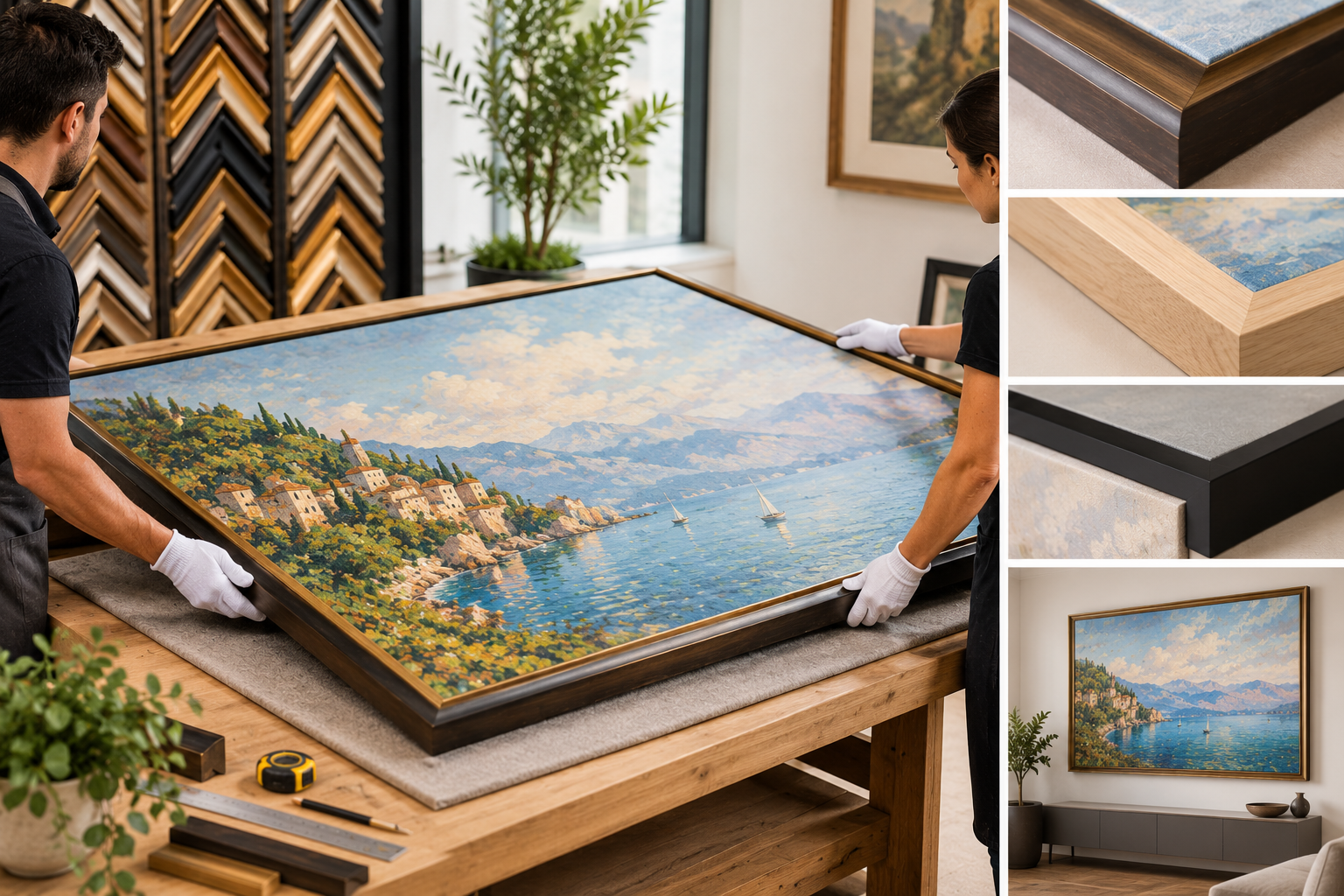
The best way to frame a large canvas painting (roughly 40 inches and above on its longest side) is to use reinforced stretcher bars with cross-bracing to prevent sagging, choose gallery-depth bars for structural rigidity, hang using multiple weight-rated points or a French cleat system rather than a single hook, and plan delivery and installation around doorway and elevator dimensions in advance. Framing is optional at any size, but at large scale a frame adds genuine structural support, not just visual finish. Online canvas framing in Dubai should flag these requirements automatically once a canvas crosses into large-format sizing.
A large canvas isn't just a small canvas scaled up — past a certain size, it becomes a different engineering problem entirely. The stretcher bars that hold a 16x20 perfectly taut will flex and sag across a 48x60 canvas. The hanging hook that safely holds a small piece isn't rated anywhere near what a large, heavy canvas actually weighs. Framing at scale means solving for structure first and appearance second.
This covers what changes once a canvas gets genuinely large — reinforcement, hardware, framed-or-not at scale, and the delivery logistics that trip up more large orders than any aesthetic decision does.
Why Size Changes Everything
Canvas fabric has some natural give, and stretcher bars are only so rigid. At small sizes, this is irrelevant — the bars easily out-stiffen the fabric's pull. Past roughly 40 inches on the longest side, the canvas's own weight and the fabric's tension start to flex standard bars, which is what causes the visible sagging or bowing sometimes seen in the centre of large unframed canvases a year or two after hanging.
Structural Reinforcement: What Actually Prevents Sagging
• Cross-bracing — a centre support bar (or an X-brace for very large pieces) fitted behind the canvas, connecting the stretcher frame's opposite sides to resist flex
• Thicker, kiln-dried wood stretcher bars — standard pine bars that work fine at small sizes aren't rigid enough alone once a canvas exceeds roughly 40 inches
• Corner bracing — reinforced joins at each corner, since this is where stress concentrates most as a large canvas is lifted, moved, or hung
Reputable large-format canvas printing and stretching automatically includes cross-bracing past a certain size threshold — if a quote for a large canvas doesn't mention it, it's worth asking directly.
Stretcher Bar Depth for Large Pieces
|
Canvas Size (longest side) |
Recommended Bar Depth |
Cross-Bracing |
|
Up to 24 in |
0.75–1.5 in standard |
Not usually needed |
|
24–40 in |
1.5 in gallery depth |
Recommended |
|
40–60 in |
1.5–2 in reinforced |
Required |
|
Over 60 in |
2 in+ reinforced, multi-brace |
Required, often with X-bracing |
Hanging Hardware for Large, Heavy Pieces
This is the step most likely to go wrong, since the hardware that works fine for a small canvas is often used out of habit on something far heavier.
• Never rely on a single central hook for anything above roughly 40 inches — use two or more weight-rated points spaced across the width
• A French cleat system (an interlocking wall-and-frame bracket) distributes weight evenly and is the standard professional choice for large or heavy pieces
• Confirm wall type before hanging — concrete and masonry, common in Dubai buildings, need drilled anchors rather than adhesive or light picture hooks at this scale
• For anything over roughly 15 kg, locate studs or use heavy-duty toggle anchors rather than standard wall plugs
Framed or Unframed at Large Scale
The framed-versus-unframed choice still applies at large sizes, but the stakes are higher. An unframed large canvas relies entirely on its own stretcher bar strength and bracing for rigidity, with nothing external reinforcing it. A frame around a large canvas — particularly a sturdy traditional frame — adds genuine structural support on top of the stretcher bars, not just a finished look, which is part of why framing becomes more functionally valuable, not just aesthetically optional, as size increases.
Multi-Panel Alternatives for Very Large Walls
For genuinely oversized spaces, splitting one image across two or three separate canvases (a diptych or triptych) is a practical alternative worth considering before committing to one enormous single piece:
• Each panel is individually lighter, easier to transport, and easier to hang than one oversized canvas
• Panels can be adjusted slightly after installation without rehanging an entire massive piece
• The look reads as intentionally gallery-style rather than compromised
• The main trade-off is a visible gap between panels, which some images (architectural, abstract) hide better than others (a single continuous face or horizon line)
Delivery and Installation Logistics
⚠ Measure the Path, Not Just the Wall
Before ordering a large canvas, measure doorways, hallway turns, staircases, and lift dimensions along the entire delivery path — a canvas that fits the wall perfectly can still fail to get through the building.
⚠ Plan for Two-Person Handling
Anything over roughly 40 inches on its longest side should be assumed to need two people for safe handling during delivery and installation, both to prevent damage and to prevent injury.
⚠ Ask About Rolled vs. Stretched Delivery
For very large pieces, some printers deliver the canvas rolled (unstretched) and complete final stretching on-site, which can solve doorway and lift size limitations that a pre-stretched piece cannot.
Common Mistakes With Large Canvas
• Using standard-depth, non-reinforced stretcher bars on a canvas well past the size they're rated for
• Hanging a large, heavy canvas on a single central hook rated for a fraction of its actual weight
• Not measuring the full delivery path before ordering, leading to a piece that can't reach its intended wall
• Skipping cross-bracing to save a modest cost, then dealing with visible sagging a year or two later
How Online Canvas Framing in Dubai Handles Large-Format Orders
Large canvas has enough genuine technical requirements that a good online canvas framing service should apply them automatically rather than leaving reinforcement and hardware choices to the buyer to request. Pickframes applies cross-bracing and appropriate stretcher depth automatically once a canvas size crosses into large-format territory, and flags delivery planning for genuinely oversized pieces before the order is finalised.
1. Confirm your canvas size and whether it falls into large-format territory (roughly 40 inches and above)
2. Choose reinforced, cross-braced stretcher bars appropriate to that size
3. Decide framed or unframed, understanding a frame adds real structural value at this scale
4. Consider a multi-panel alternative for genuinely oversized walls
5. Measure your full delivery path before confirming online canvas framing in Dubai for delivery
Frequently Asked Questions
At what size does a canvas need structural reinforcement?
Generally once the longest side exceeds around 40 inches, cross-bracing and thicker stretcher bars become important to prevent the canvas from sagging or bowing in the centre over time.
What's the safest way to hang a large, heavy canvas?
Use two or more weight-rated hanging points, or a French cleat bracket system, rather than a single central hook. Confirm wall type and use drilled anchors on concrete or masonry for anything over roughly 15 kg.
Should a large canvas be framed or left unframed?
Either is possible, but a frame adds genuine structural support at large scale, not just a finished look, which makes framing more functionally valuable than it is for smaller pieces.
What is a multi-panel canvas and when is it a better choice than one large piece?
A multi-panel canvas splits one image across two or three separate stretched pieces (a diptych or triptych), making each panel lighter and easier to transport and hang than a single oversized canvas, which suits genuinely large walls well.
What should I check before ordering online canvas framing in Dubai for a large piece?
Measure the full delivery path, including doorways, hallway turns, and lifts, not just the wall space. Confirm the order includes cross-bracing and appropriate stretcher bar depth for the size.
A Note on Humidity and Large Canvas in Dubai
Large canvas has more surface area exposed to humidity swings than a small piece, which means the gap between a hot, humid exterior and a cool, dry, air-conditioned interior common in Dubai homes has more fabric to act on. This is a secondary reason reinforced bracing matters here specifically: a well cross-braced stretcher resists the subtle expansion and contraction that comes with those swings far better than a standard frame does across a large surface area. It's a small factor compared to weight and structural sag, but worth factoring in in this climate specifically.
Framing a large canvas well is mostly a structural question dressed up as an aesthetic one — reinforced bars, rated hanging hardware, and a measured delivery path matter more at this scale than frame colour or style. Get those fundamentals right, consider a multi-panel approach for genuinely oversized walls, and online canvas framing in Dubai can handle the engineering so the piece looks as good in five years as it does on day one.