
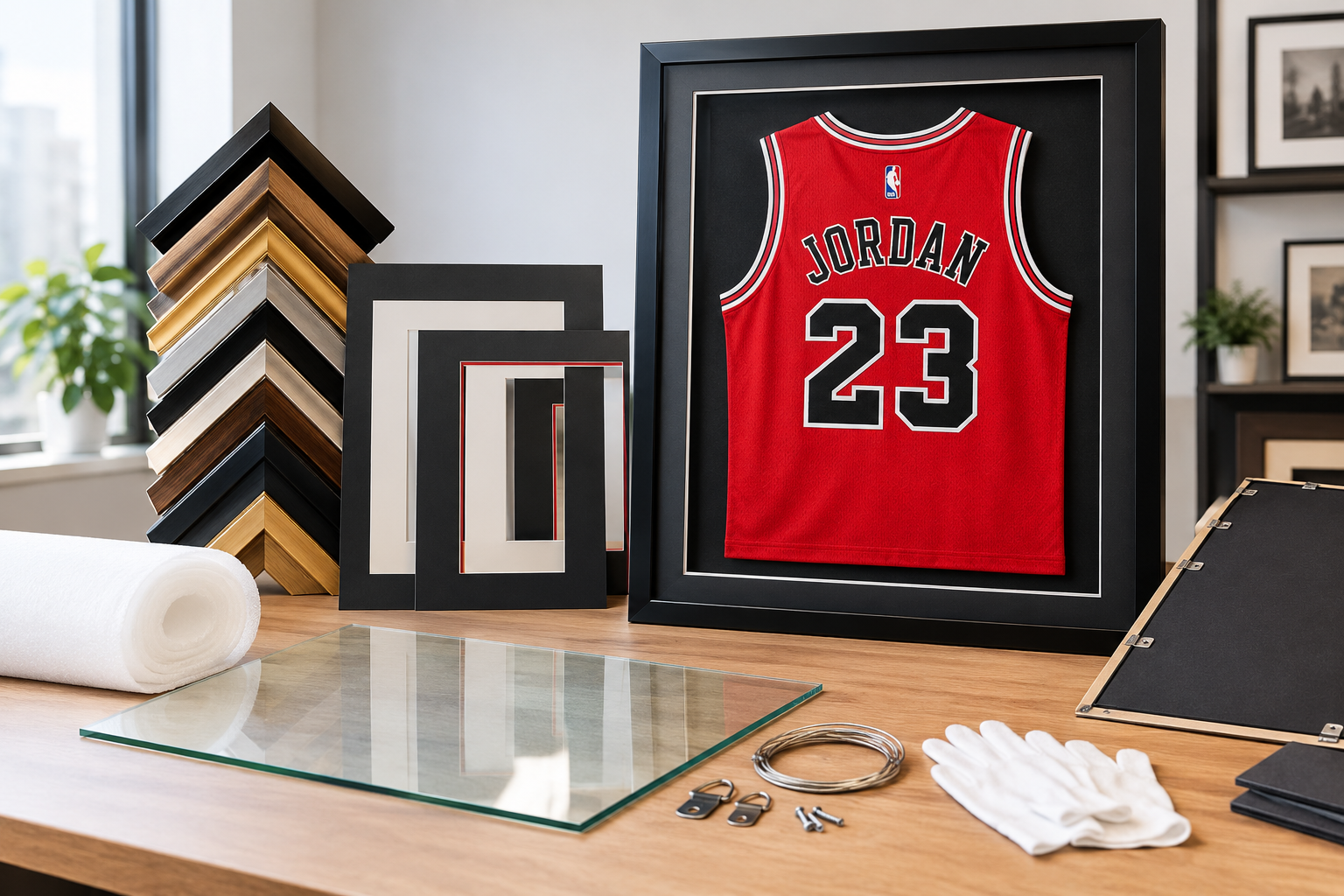
Professional jersey framing typically uses a deep wood or metal frame, UV-protective glass or acrylic, acid-free mount boards and backing, archival thread or stainless-steel pins to hold the shirt, a dust-proof sealed back and sturdy hanging hardware. Premium work adds museum-grade glass and reversible mounting. Add-ons such as engraved metal plaques and printed photos are common for tribute displays. In Dubai, jersey framing starts from around AED 250 for a simple frame, with materials and extras driving the price up from there.
Two frames can hang side by side and look identical on day one. Ten years later, one still looks crisp while the other has a yellowed mount, a faded shirt and a signature that has started to blur. The difference is almost never the design. It is what the frame is made of.
Professional jersey framing is really a stack of carefully chosen materials, each doing a specific job: holding the shirt, protecting it from light, keeping acid away from the fabric and carrying the weight on your wall. This guide takes you through that stack layer by layer, explains what each material does, and tells you what to ask a framer so you can tell quality from cosmetics. It is written for anyone considering Jersey/T Shirt framing in Dubai, where strong sunlight makes material choices matter even more.
The Materials Stack at a Glance
Think of a framed jersey as layers, from the front to the wall. This table shows each one and why it exists.
|
Layer |
Typical material |
Job it does |
|
Frame |
Solid wood, metal or composite; deep shadow box profile |
Holds everything together and provides depth |
|
Glazing |
UV-protective glass or acrylic; museum-grade or anti-reflective options |
Protects from dust and light, slows fading |
|
Spacer |
Acid-free strips or the box depth itself |
Keeps the shirt off the glass |
|
Mount boards |
Acid-free, often layered, with custom-cut windows |
Frames photos, badges and the shirt visually |
|
Mounting |
Archival thread or stainless-steel pins |
Holds the shirt without adhesive |
|
Backing board |
Acid-free board, or reinforced MDF or foam core with a sealed finish |
Supports the shirt and the whole assembly |
|
Seal |
Dust-proof backing paper or tape |
Keeps out dust, insects and moisture |
|
Hardware |
Hooks, D-rings, wire or cleats rated for the weight |
Hangs the frame safely |
The Frame: Wood, Metal or Composite
The frame is the most visible material, but its main job is structural. A jersey needs more room than a photo, so professionals build or choose a deep shadow box profile. Published specifications from Dubai framers describe depths from about 3 cm for slim designs to 5–7 cm for large layouts, and a common international guide suggests at least 3 cm as a minimum.
• Solid wood is the traditional choice. It is strong, can be stained or painted in almost any colour and suits classic or warm interiors.
• Metal profiles, usually aluminium, give a slim, modern look and stay rigid. Some Dubai designs use a metallic edge finish on a deep black box.
• Composite or polystyrene mouldings are lighter and more affordable, though they may be less sturdy for very large, heavy displays.
Ask which material the frame is made from and whether the corners are properly joined. A wobbly corner on a deep box is a sign of weak construction.
Glazing: The Material That Protects Against Dubai’s Sun
If you spend extra money in one place, make it the glass. Sunlight does more long-term damage to a jersey than almost anything else, and it also fades signature ink. Common glazing options include:
|
Type |
What it offers |
Best for |
|
Standard glass |
Clear and affordable, with little UV filtering |
Low-value shirts in dim rooms |
|
UV-protective glass or acrylic |
Filters most ultraviolet light and slows fading |
Most jerseys, and a sensible default in Dubai |
|
Conservation or museum-grade glass |
Rated by some brands to block around 99 per cent of UV, often with low reflection |
Signed, game-worn, vintage or valuable pieces |
|
Anti-reflective glass |
Cuts glare so the shirt is easy to see |
Bright rooms and spotlit walls |
|
Acrylic (Plexiglass) |
Lighter than glass and shatter-resistant |
Very large frames and homes with children |
Dubai framers publish partnerships with specialist glazing makers such as Tru Vue and Groglass, so it is reasonable to ask which product is being used and what UV rating it carries. Remember that even the best glass slows fading rather than stopping it, so hanging position still matters.
Mount Boards: Acid-Free Is Not Negotiable
Mount boards, sometimes called mats, form the coloured borders and windows around the shirt, photos and badges. They also sit close to the fabric, so their chemistry matters. Ordinary paper board contains acids that migrate into nearby materials, causing yellowing and brittleness.
• Acid-free boards are chemically neutral and are the baseline for professional work.
• Conservation or museum boards go further, using high-purity materials designed to last decades.
• Layered mounts combine two or three boards to add depth and colour. Some Dubai designs use triple-layered acid-free boards with custom-cut windows.
• Fabric-covered or suede mounts add texture and are sometimes used in premium tribute layouts.
A simple test: ask the framer, “Are all the boards touching the shirt acid-free?” A confident yes is what you want.
Mounting Materials: How the Shirt Is Actually Held
This is the most important decision in the whole project, and the one most buyers never see. The shirt must be held firmly enough to avoid sagging, yet gently enough that it can be removed without a mark.
• Archival thread. Fine thread stitched through hidden areas such as hems and seams holds the shirt in place and spreads the load.
• Stainless-steel pins. Rust-proof pins placed through hems or alongside the fabric are a common alternative, especially for pin-mounted layouts.
• Support padding. Acid-free foam or board shapes under collars and sleeves keep the shirt’s natural form.
• What good framers avoid. Glue, double-sided tape, spray adhesive and dry mounting leave residue and cannot be reversed.
Dubai framers describe their methods as “archival pin or stitch mounting” for good reason. If a framer cannot tell you how the shirt is held, treat that as a warning.
Backing Board and Sealing
Behind the shirt sits a backing board that supports the whole assembly. Published specifications mention acid-free board, and reinforced MDF or foam core with a moisture-resistant, dust-sealed finish. The key requirement is that any board touching or close to the shirt is acid-free, and that the back is sealed so dust, insects and humidity stay out. In a city with strong seasonal humidity swings, a properly sealed back is worth checking.
Hanging Hardware: The Unsung Material
A deep jersey frame is heavy. Glass, a thick moulding and a mounted shirt can weigh much more than a normal picture. Professionals use hanging hardware rated for the weight, such as D-rings with strong wire, hooks, or French cleats, and they match the fixings to your wall type. Ask what the frame weighs and what hardware is supplied, and whether installation is offered.
Add-On Materials for Tribute Displays
• Engraved metal plaques with the player’s name, date or event.
• Printed photographs, ideally on archival-quality paper with fade-resistant inks, shown in custom windows.
• Club crests or logos, printed or embroidered, mounted beside the shirt.
• Velvet or felt linings in some display cases for a soft background.
• Signature cut-outs, where the mount is cut to reveal an autograph clearly.
T-Shirt Framing: Do the Materials Change?
The principles stay the same for T shirt framing, but some materials can be lighter. Cotton tees are thin and flexible, so they may fit a shallower frame and need less backing support. The mounting method is still archival, and acid-free boards and UV protection still apply. For a printed or heat-pressed design, the framer should avoid pressure and heat on the graphic. T shirt framing in Dubai for a signed or rare tee should use the same conservation-minded materials as a signed jersey.
Material Red Flags
• The framer cannot say whether boards and backing are acid-free.
• The shirt is held with glue, tape or spray adhesive.
• Only standard glass is offered for a signed or valuable shirt.
• The frame is shallow, so the fabric touches the glass.
• The back is not sealed.
• No details are given about the glass brand or UV rating.
Questions worth asking before you book:
1. Are the mount boards and backing acid-free?
2. How is the jersey held, and is it fully reversible?
3. Which glass or acrylic is used, and what UV protection does it offer?
4. How deep is the frame, and will the shirt touch the glass?
5. Can I see a recent jersey you have framed?
Do Better Materials Cost More? Yes, and Here Is Where It Counts
Materials drive cost. In Dubai, jersey framing starts from around AED 250, and shadow box framing from around AED 300, while museum-grade glass, multi-window layouts and engraved plaques are normally quoted per project. If you need to prioritise, spend on this order: first the mounting method and acid-free materials, then UV glass, then frame depth, and only then decoration. Protection protects the shirt. Decoration only decorates it.
Choosing Materials When You Mail Your Jersey In
If you live in Abu Dhabi, Sharjah or elsewhere in the UAE, a mail-in service lets you choose a frame and leave the delicate mounting to specialists. With Pickframes, you choose your jersey type, pick a frame, and receive a secure mailer to send the shirt to the studio. You can start your jersey framing here, and learn more about UV art glass options. Always ask to see the materials list before you confirm.
Frequently Asked Questions About Jersey Framing Materials
1. What materials are used in professional jersey framing?
Professional jersey framing uses a deep wood or metal frame, UV-protective glass or acrylic, acid-free mount boards and backing, archival thread or stainless-steel pins to hold the shirt, and a sealed back. Premium work adds museum-grade glass and reversible mounting. Tribute designs may include engraved plaques, printed photos and club crests.
2. Why does acid-free material matter for a jersey?
Ordinary paper board contains acids that move into nearby fabric over time, causing yellowing, staining and brittleness. Acid-free and conservation boards are chemically neutral, so they protect the shirt for years. Any board that touches or sits close to the jersey should be acid-free, including the mounts and the backing.
3. What type of glass is best for framing a jersey in Dubai?
UV-protective glass or acrylic is a sensible default, because Dubai’s strong sunlight fades fabric and ink. For signed, game-worn or valuable shirts, conservation or museum-grade glass, rated by some brands to block around 99 per cent of UV light, is worth the upgrade. Anti-reflective options cut glare in bright rooms.
4. How is a jersey held in a frame without damaging it?
Professionals use archival thread stitched through hidden areas such as hems, or stainless-steel pins placed carefully, along with acid-free support padding. These methods are reversible and leave no adhesive residue. Glue, tape and spray adhesive should be avoided, because they can mark the fabric permanently.
5. Are the materials different for T-shirt framing?
The principles are the same, with acid-free boards, UV protection and archival mounting, but cotton T-shirts are thinner, so they can often sit in a shallower frame with less backing support. Printed or heat-pressed designs need extra care to avoid pressure and heat. A signed or rare tee deserves the same conservation-grade materials as a jersey.
A jersey frame is only as good as its materials. Look for acid-free boards, reversible mounting, UV-protective glazing, enough depth and a sealed back, and ask for them in writing. Whether you are arranging Jersey Framing in Dubai for a signed collector’s piece or T shirt framing in Dubai for a favourite tee, the right materials mean the shirt still looks as good in a decade as it does the day it goes on the wall.