
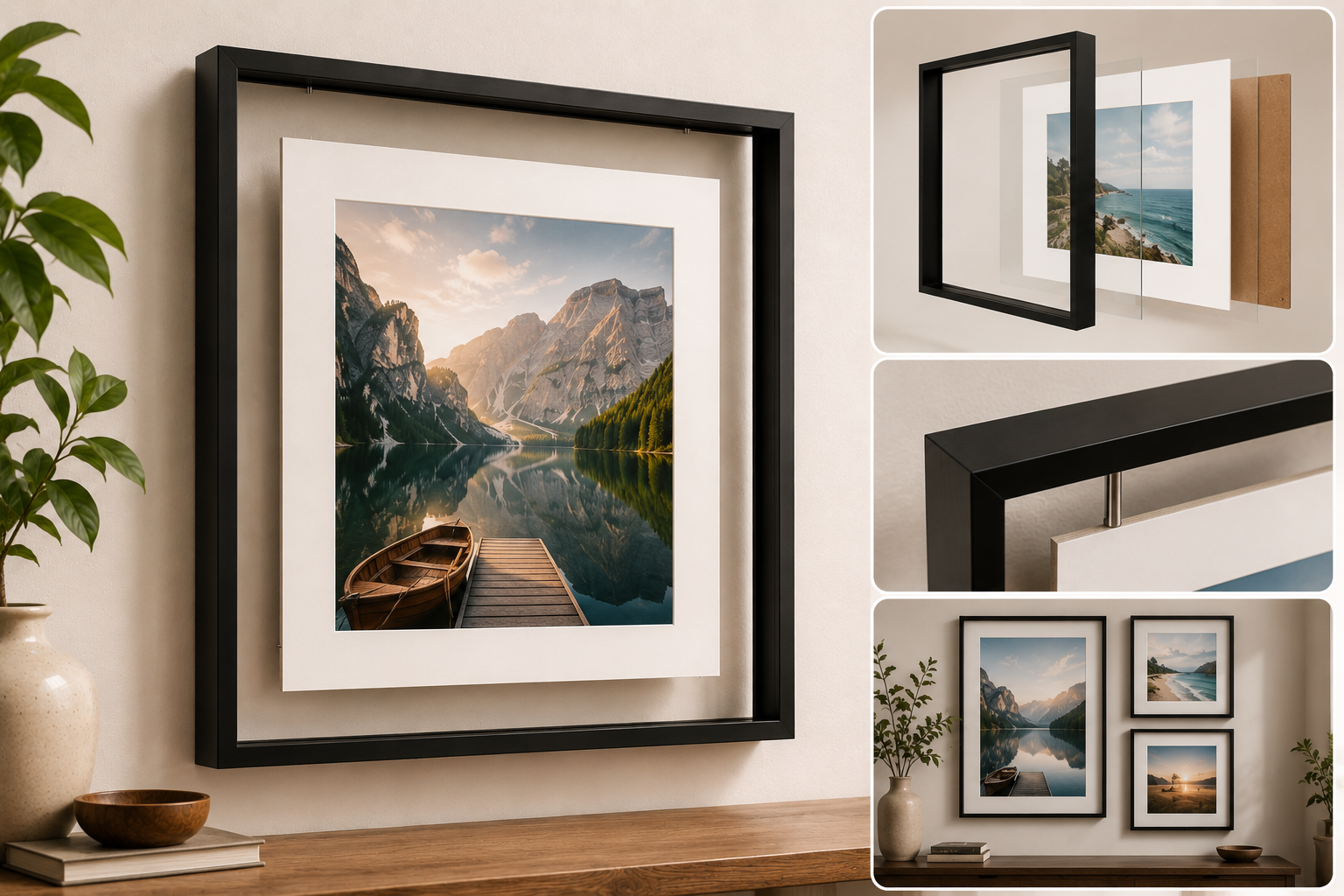
A floating frame is a shallow frame with a recessed inner edge that holds artwork slightly away from the frame's border, creating a visible gap so the piece appears to "float" inside it rather than being covered by the frame. It's most commonly used for canvas prints, wood panel art, and thicker artworks where you want the edges of the piece to stay visible. Use a floating frame when your art has a finished, paint-wrapped edge you want to show off, or when you want a modern, gallery-style presentation without a traditional mat or glass covering the image.
The Frame That Doesn't Touch the Art
If you've ever walked through a modern art gallery and noticed a canvas painting that seems to hover slightly inside its frame — with a thin shadow gap running around the edge — you've seen a floating frame in action. It's one of those design details that looks effortless but is actually a very specific construction choice, and it's not the right fit for every piece of art.
This guide explains exactly what a floating frame is, how it physically works, when it's the smart choice, when you should skip it, and what it typically costs compared to traditional framing.
What Is a Floating Frame, Exactly?
A floating frame is built with a recessed channel or lip on its inner edge. Instead of the frame's face overlapping the front of the artwork (like a traditional frame does), the artwork sits inside that recessed channel with a visible gap — usually a quarter-inch to half-inch — between the edge of the art and the inner edge of the frame.
The result: you see a thin strip of wall (or backing) all the way around the artwork, which creates the illusion that the piece is floating in space rather than being framed in the conventional sense. It's a construction detail borrowed from professional art galleries, where curators have used this technique for decades to display gallery-wrapped canvases and fine art without hiding a single centimeter of the piece.
Floating Frame vs. Traditional Frame: What's Actually Different
|
Feature |
Traditional Frame |
Floating Frame |
|
Contact with artwork |
Frame face overlaps the edges of the art |
Frame does not touch the front surface; a gap is left visible |
|
Best suited for |
Paper prints, posters, photos, documents |
Canvas prints, wood panels, gallery-wrapped art |
|
Glass or acrylic |
Usually included |
Usually omitted (canvas doesn't need glazing) |
|
Visual effect |
Classic, contained, formal |
Modern, gallery-style, appears to hover |
|
Mat board |
Common |
Rarely used |
|
Shows painted/finished edges |
No — edges are covered |
Yes — edges remain fully visible |
When You Should Use a Floating Frame
Floating frames aren't just a style preference — they solve specific display problems. Here's when they genuinely make sense:
1. Your Artwork Is a Gallery-Wrapped Canvas
If you've had a photo turned into a canvas print with the image wrapped around the sides (a gallery wrap), a floating frame lets that wrapped edge stay visible instead of hiding it behind a frame lip. This is one of the most common and most satisfying uses of a floating frame.
2. You Want the Art to Feel Modern and Minimal
Floating frames read as contemporary. If your space leans toward a modern, minimalist, or Scandinavian aesthetic, a floating frame complements that look far better than an ornate traditional frame ever could.
3. The Piece Has a Textured or Painted Edge Worth Showing
Original paintings on canvas or wood panel often have texture, brushstrokes, or color that continues onto the edges. Covering that with a standard frame lip hides part of the artist's work — a floating frame keeps it on display.
4. You're Framing a Thicker Panel or Board
Wood panel prints, cradled boards, and deep-edge canvases are often too thick for a standard frame rabbet (the recessed groove that holds artwork). Floating frames are typically built with deeper, adjustable channels designed for this extra thickness.
5. You Want a Cohesive Look Across a Gallery Wall of Canvases
When displaying several canvas pieces together, floating frames in a matching wood tone create a unified, curated look without each piece feeling boxed in.
When a Floating Frame Is the Wrong Choice
Floating frames are a specialty product, not a universal upgrade. Skip them in these situations:
• Paper photos or prints — without glass, paper artwork is unprotected from dust, humidity, and UV exposure; a traditional frame with glazing is safer.
• Documents or certificates — these need the flat, fully covered protection a standard mat-and-glass frame provides.
• Very thin or lightweight paper posters — they can shift or warp inside the recessed channel without the support a standard frame backing gives them.
• Budget-sensitive projects — floating frame hardware and construction is more specialized, which usually puts it above basic frame pricing.
• Art with unfinished or unattractive edges — if the sides of your canvas are blank, stapled, or uneven, a floating frame will expose that; a traditional wrap-around frame hides it instead.
Types of Floating Frames Worth Knowing
|
Type |
Description |
|
Standard floating frame |
Single frame with a recessed channel on all four sides; most common type. |
|
Deep floating frame |
Extra-wide channel for thick canvases, cradled panels, or 3D mixed-media pieces. |
|
Open-corner floating frame |
Frame corners are slightly open rather than mitred flush, emphasizing the floating effect even more. |
|
Two-tone floating frame |
Combines two frame colors or finishes — often a dark inner channel with a lighter outer edge — for added contrast. |
Design Trends: Floating Frames in 2026
• Natural wood tones (oak, walnut, ash) are outperforming painted white or black floating frames this year.
• Thin-profile floating frames — narrower, more minimal channels that barely register as a frame at all.
• Matte black floating frames paired with black-and-white photography canvases for a high-contrast gallery look.
• Floating frames used on large-format canvas wall art as a single statement piece, replacing multi-photo gallery walls in some modern interiors.
• Sustainable and reclaimed-wood floating frame options, as buyers lean toward eco-conscious materials.
Floating Frame Pricing: What to Expect
Floating frames generally cost more than a comparably sized traditional frame because of the specialized channel construction and the extra depth of moulding required. Typical pricing factors include:
|
Factor |
Impact on Price |
|
Frame size |
Larger canvases require more moulding and structural support — cost scales with perimeter, not just area. |
|
Wood species / finish |
Natural hardwoods and premium finishes cost more than basic painted mouldings. |
|
Frame depth |
Deep floating frames for thick or cradled canvases require more material and cost more than standard-depth options. |
|
Canvas printing + framing bundle |
Many shops offer combined canvas printing and framing services — bundling is often more cost-effective than ordering separately. |
Exact picture framing prices vary by shop, materials, and canvas size — request a quote with your specific dimensions for an accurate number.
Is a Floating Frame Right for Your Piece? Quick Checklist
Check off the statements that apply to your artwork. Three or more checks means a floating frame is likely a strong fit.
☐ My artwork is a canvas print or painted panel, not paper.
☐ The edges of my piece are finished, wrapped, or visually appealing.
☐ I want a modern, gallery-style presentation rather than a classic look.
☐ My piece doesn't need glass protection (it's not paper-based).
☐ I'm okay with a slightly higher framing cost for the specialized construction.
Common Mistakes to Avoid
• Ordering a floating frame for a thin paper print — it won't sit securely in the recessed channel and offers no protective glazing.
• Choosing a channel width that's too tight for the canvas thickness — always confirm your canvas depth before ordering.
• Assuming all frame shops build true floating frames — some sell "floater-style" mouldings that are really just deep traditional frames; ask specifically about the recessed channel construction.
• Skipping a finish sample — wood tone can look different in person than in a photo; request a swatch before committing on a large, expensive canvas.
Frequently Asked Questions
1. What is a floating frame used for?
A floating frame is used to display canvas prints, painted panels, and gallery-wrapped artwork in a way that keeps the piece's edges visible, creating a modern effect where the art appears to hover slightly inside the frame rather than being covered by it.
2. Can you put a photo in a floating frame?
Only if the photo has been printed onto canvas or a rigid panel. Standard paper photo prints are not suitable for floating frames because they lack the thickness to sit in the recessed channel and typically need glass protection that floating frames don't include.
3. Is a floating frame more expensive than a regular frame?
Generally yes — floating frames require specialized construction with a recessed channel and are often built from deeper moulding, which increases material and labor cost compared to a standard traditional frame of the same size.
4. Do floating frames need glass?
No, floating frames are typically used without glass because they're designed for canvas and panel artwork, which doesn't require glazing the way paper prints do. The absence of glass is also part of what allows the piece to sit within the recessed channel.
5. What size gap should a floating frame leave around the artwork?
Most floating frames leave a gap of about a quarter-inch to half-inch between the edge of the artwork and the inner edge of the frame, though this can be adjusted based on the size of the piece and the visual effect you want — a wider gap creates a more dramatic floating illusion.
Ready to Frame Your Canvas the Right Way?
A floating frame can turn a good canvas print into a genuine centerpiece — but only when it's matched to the right kind of artwork. If you're not sure whether your piece is a good candidate, share a photo and its dimensions with our framing team and we'll recommend the right construction and finish.