
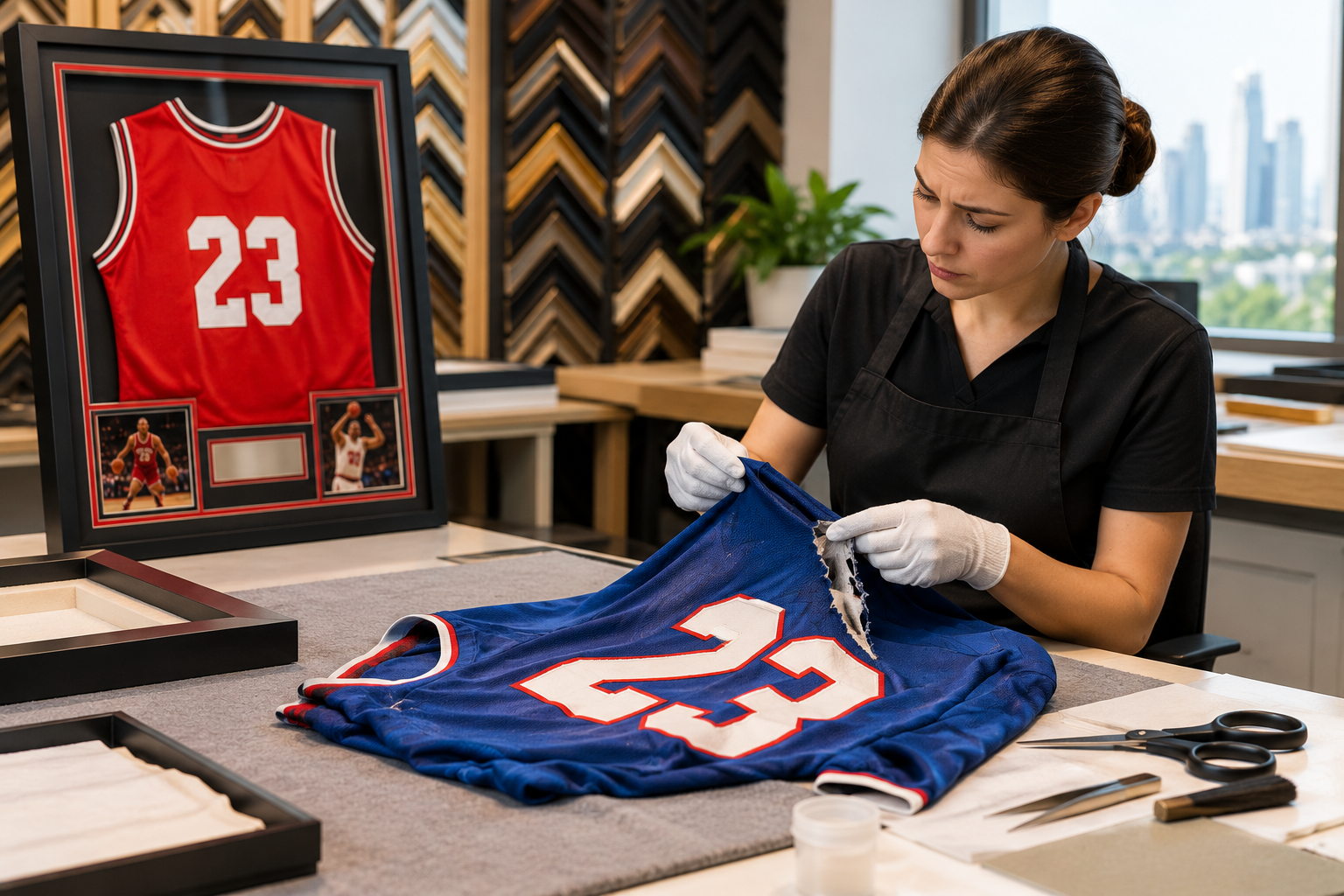
If your jersey is damaged during framing, a reputable framer should tell you promptly, show you what happened, and offer a fair remedy, such as repair, replacement of the frame, a redo, a refund or compensation, depending on the case and their policy.
For many people, a jersey is the one item they cannot replace. It might be signed, match-worn, a gift or a link to someone they love. Handing it to a framer, or posting it to a studio, means trusting that it will come back in better shape than it left. So it is a fair question to ask: what happens if something goes wrong?
This guide gives you a straight answer. It explains how damage can happen, how good framers prevent it, what a responsible studio does if a problem occurs, what you can do before and after to protect yourself, and which questions to ask up front. It is written for anyone considering Jersey/T Shirt framing in Dubai or other Custom Framing in Dubai, and who wants to know where they stand.
How Can a Jersey Be Damaged During Framing?
Most damage is not dramatic. It comes from small, avoidable mistakes at one of a few stages.
|
Stage |
What can go wrong |
How it is usually prevented |
|
Transport |
Crushing, creasing, heat, water or loss in transit |
Secure packaging, tracking and careful handling |
|
Handling |
Stains, smudged signatures, skin oils, snagging |
Clean hands or gloves, clean work surfaces |
|
Preparation |
Over-ironing, steaming or pressing printed areas |
Gentle smoothing, no heat on prints or ink |
|
Mounting |
Pins or stitches through signatures, holes, puckering |
Archival stitching placed in hems and seams |
|
Materials |
Acid or adhesive causing yellowing or marks |
Acid-free backing, no glue or tape |
|
Glazing |
Glass touching the shirt, ink transfer, glare |
Depth, spacers and UV-protective glass |
|
Assembly |
Sagging, loose backing, gaps for dust and insects |
Proper sealing and construction |
|
Delivery |
Cracked glass or a knocked frame |
Protective packing and careful delivery |
The good news is that every one of these risks is well understood, and a careful framer has a routine for each.
The Risks Are Different for Jerseys
Fabric is harder to frame than paper. It stretches, creases, snags and carries ink and printed numbers that react to heat and pressure. A framer who mainly handles prints and photographs can make mistakes with a jersey that they would never make with paper.
• Signatures can smudge, lift or fade if touched, pinned through or pressed against glass.
• Printed numbers and badges can crack or peel under heat or pressure.
• Mesh and technical fabrics can snag, stretch or distort when pinned.
• Older or vintage shirts can be brittle, and may tear when handled.
That is why experience with fabric matters when you are choosing someone for Jersey Framing.
How Good Framers Prevent Damage
A responsible studio builds prevention into the process. Here are the signs of a careful one.
• Condition check on arrival. The shirt is inspected and photographed when it arrives, so everyone knows its starting condition.
• Clean handling. Clean hands or gloves, clean surfaces and no food or drink nearby.
• Reversible mounting. Archival stitching or stainless pins, placed in hems and seams and away from signatures. Published Dubai specifications describe archival pin or stitch mounting as standard.
• No adhesives. No glue, tape or spray mount touching the shirt.
• Acid-free materials. Backing and mounts that will not stain the fabric.
• Depth and spacers. Enough room that the glass does not touch the shirt or signatures.
• UV-protective glazing. Some brands rate their conservation glass at around 99 per cent UV blocking.
• A second check. A final inspection before the frame is sealed and packed.
What a Responsible Framer Does If Something Goes Wrong
Even careful studios can have an accident. What matters is what happens next. A responsible framer will:
1. Stop and assess. They will not try to hide the problem or rush a fix.
2. Tell you promptly and honestly, with a clear description of what happened.
3. Show you, with photographs, so you can see the damage for yourself.
4. Explain the options, such as repair, conservation work, a redo of the frame or compensation.
5. Follow their written policy, and be open about what it covers.
6. Fix what can be fixed, and tell you honestly what cannot.
7. Learn from it, so that it does not happen again.
If a framer avoids the subject, blames you without evidence or refuses to put anything in writing, that is a warning sign.
What Remedies Are Possible?
What you can expect depends on the type of damage, the framer’s policy and the shirt itself. Common outcomes include:
• Fixing a framing fault, such as a crooked mount, loose backing or a cracked glass, usually by redoing the frame at no extra charge.
• Repositioning or re-mounting a shirt that was mounted poorly.
• Professional cleaning or conservation for stains or marks, where it is safe and possible.
• A refund or credit for the framing work.
• Compensation for damage to the shirt, where the framer accepts responsibility and the terms allow it.
Be realistic about irreversible damage. A faded signature, a torn vintage shirt or a lost print cannot always be restored, which is why prevention and clear terms matter so much. For a rare or valuable jersey, ask the framer how they would handle a loss, and consider getting the shirt valued or insured separately.
How to Protect Yourself Before You Hand It Over
1. Photograph the jersey front and back, close up, in good light, including signatures, numbers, labels and any existing marks.
2. Write down the details: brand, size, signers, date and any certificate of authenticity.
3. Ask for the framer’s policy in writing: handling, damage, guarantee and insurance.
4. Ask how the shirt will be mounted and what materials will touch it.
5. Agree the price and timeline in a written quote.
6. Keep the receipts, emails and messages.
7. Consider declaring a value if the shirt is rare, and ask whether your own home or collectables insurance covers it.
These steps take about ten minutes, and they make any later conversation much simpler.
Choosing a Framer You Can Trust
The best protection is a careful framer. When comparing studios for Custom Framing in Dubai, look for these signs:
• Clear explanations of materials and mounting.
• Examples of previous jersey or fabric work.
• A written, itemised quote.
• A clear policy on damage, remakes and guarantees.
• Prompt, polite and specific communication.
Our guide on how to tell if a framing shop is reputable has a fuller checklist.
Damage Concerns With T-Shirts
T Shirt framing carries the same risks, with a few of its own. Cotton tees can stretch or crease when pinned, printed designs can crack, and thin fabric can show stitch marks if it is mounted badly. A signed or vintage tee deserves the same care as a jersey. When you ask about T shirt framing in Dubai, ask how the shirt will be supported, and how the print will be protected.
How Pickframes Approaches It
With Pickframes, you choose your jersey type, pick a frame and see the price upfront before you order. If you live in Dubai, Abu Dhabi, Sharjah or elsewhere in the UAE, a secure mailer is sent so you can send your shirt to the studio, the estimated delivery is shown at checkout, and there is a happiness guarantee. You can start your jersey framing here. If you want to understand the handling, damage and guarantee terms for a particular shirt before you order, contact the team and ask.
Questions to Ask Before You Hand Over Your Jersey
• How will you inspect and record the condition of my shirt?
• How will it be mounted, and is it reversible?
• What will touch the shirt, and is it acid-free?
• What happens if the shirt or frame is damaged during framing?
• Is there a guarantee, and what does it cover?
• Do you have insurance for items in your care?
• How will you pack and return it?
• Can I see the policy in writing?
Frequently Asked Questions About Jersey Damage During Framing
1. What happens if my jersey gets damaged during framing?
A reputable framer should tell you promptly, show you what happened and offer a fair remedy under their policy, such as repair, a redo of the framing, a refund or compensation. Policies differ, so ask for the damage, guarantee and insurance terms in writing before you hand over the shirt, and photograph the jersey beforehand.
2. How can I stop my jersey being damaged during framing?
Choose a framer with fabric experience who uses reversible archival mounting, acid-free materials, no adhesives and enough depth to keep the glass off the shirt. Photograph the jersey before you hand it over, get the policy in writing, pack it carefully if you send it by courier, and inspect the result on delivery.
3. Can a damaged jersey be repaired?
It depends on the damage. Framing faults such as a crooked mount, loose backing or cracked glass can usually be redone. Stains or marks may be treated by a conservator if it is safe. Faded signatures, torn vintage fabric and cracked prints often cannot be fully restored, which is why prevention matters.
4. Should I insure my jersey before framing it?
For a rare, signed or valuable jersey, it is worth considering. Ask the framer about insurance for items in their care, check whether your own home or collectables insurance covers it and, if needed, get the shirt valued. Keep photographs, receipts and any certificate of authenticity.
5. Is T-shirt framing in Dubai less risky than jersey framing?
Not necessarily. T-shirts can stretch or crease when pinned, printed designs can crack and thin fabric can show stitch marks. A signed or vintage T-shirt needs the same careful handling, archival mounting and UV protection as a jersey, so ask the framer how they will support the shirt and protect the print.
Damage during framing is rare with a careful framer, but it is a fair thing to worry about, and the best answer is preparation. Photograph your shirt, ask about methods and policies before you commit, get the terms in writing and inspect the result when it arrives. Whether you are arranging Jersey Framing in Dubai for a signed collector’s piece or Jersey/T Shirt framing in Dubai for a favourite fan shirt, a framer who is open about risk is usually the one you can trust with the shirt, and that goes for any Custom Framing in Dubai you commission.