
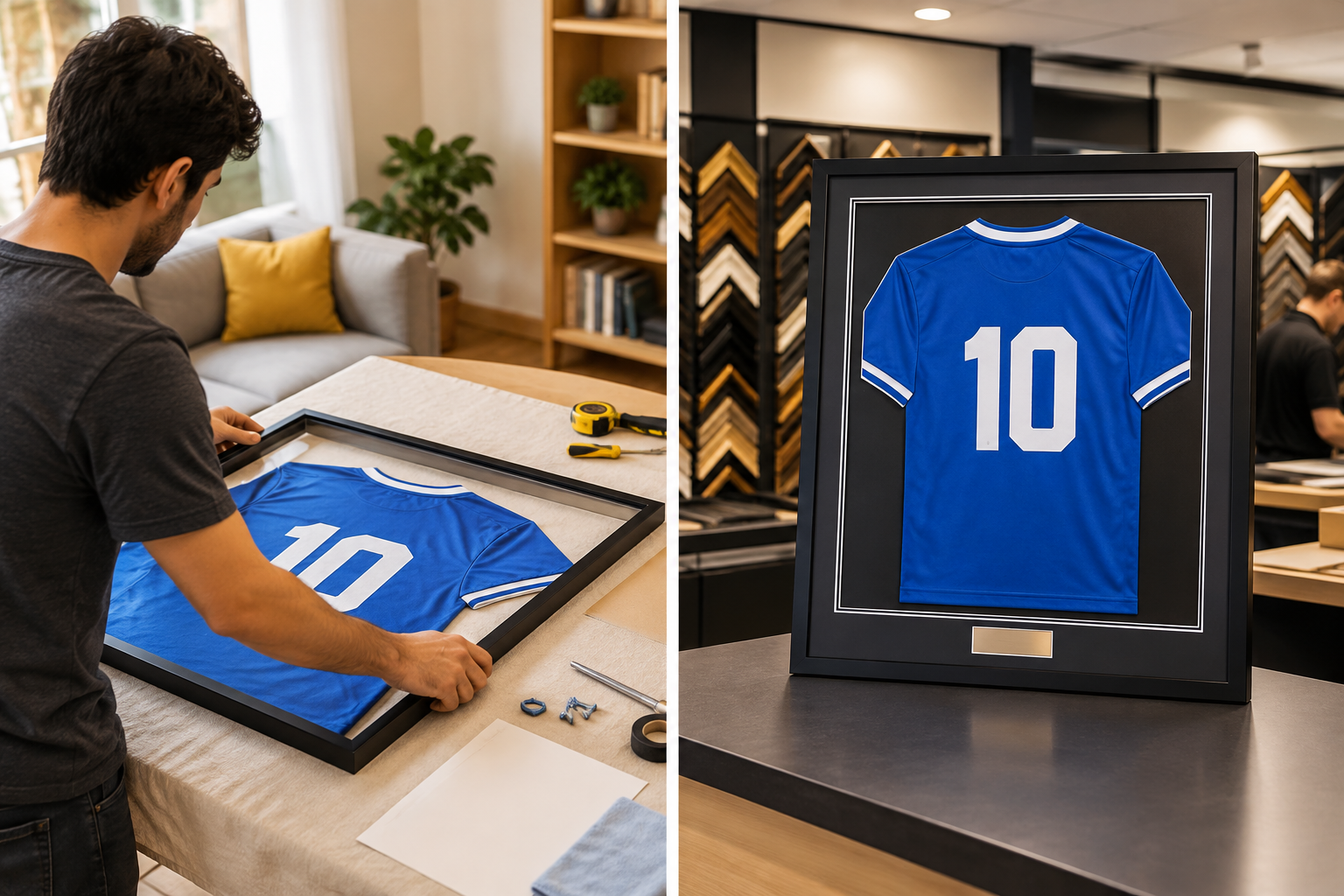
Frame at home if the shirt is a replica or low-value piece you could replace, and you are happy to accept some risk. Use a professional if the jersey is signed, game-worn, vintage or sentimental, because mistakes with glue, creases, heat or glass contact are hard or impossible to undo. In Dubai, professional jersey framing starts from around AED 250 for a simple frame, which is small next to the cost of losing a shirt you cannot replace.
Scroll through any online marketplace in the UAE and you will find ready-made jersey frames at tempting prices. Walk into a framing studio and you will be quoted more. So it is fair to ask: why not just do it yourself?
The honest answer is that sometimes you should. DIY jersey framing is a sensible choice for some shirts and a risky one for others. This guide gives you a straight comparison, a quick decision test, and a safe method for the cases where doing it at home makes sense. It also explains where professional Jersey/T Shirt framing in Dubai earns its price, so you can decide with real information instead of guesswork.
The Verdict by Situation
|
Your jersey |
Best route |
Why |
|
Replica shirt bought from a shop |
DIY is fine |
If something goes wrong, the shirt can be replaced |
|
Kid’s old school or club shirt, low sentimental risk |
DIY or professional |
Depends on how much it means to you |
|
Everyday concert or event T-shirt |
DIY or professional |
Thin cotton is forgiving, but prints can be damaged by heat |
|
Signed jersey |
Professional |
Signatures can smudge, fade or be marked by glue and glass |
|
Game-worn or match-used shirt |
Professional |
The history is the value, and it should stay untouched |
|
Vintage or fragile kit |
Professional |
Old fabric and prints can tear, lift or crumble |
|
A gift for someone special |
Professional |
Presentation and reliability matter as much as protection |
DIY vs Professional: The Scorecard
Here is a fair side-by-side look across the things that actually matter.
|
Factor |
Framing at home |
Professional framing |
|
Upfront cost |
Usually lower, especially with a ready-made frame or case |
Higher, from around AED 250 in Dubai for a simple jersey frame |
|
Protection |
Depends on the kit; UV glass and acid-free backing are not guaranteed |
Acid-free materials, UV glass and conservation options available |
|
Mounting |
Pins or stitches done by hand, with a learning curve |
Archival pin or stitch mounting by people who do it daily |
|
Look |
Often a standard, off-the-shelf layout |
Custom mounts, colours, plaques and photo windows |
|
Time |
Your own hours, plus shopping and trial and error |
A few days in most cases, with no effort from you |
|
Risk of damage |
Higher, especially with glue, heat or tight folding |
Lower, and the framer carries the responsibility |
|
Reversibility |
Depends entirely on what you use |
Reversible methods are standard for good framers |
|
If it goes wrong |
You bear the loss |
Some framers offer guarantees or warranties |
A Quick Decision Test
Answer these six questions honestly. If you say yes to any of the first four, choose a professional.
1. Is the jersey signed?
2. Is it game-worn, match-used or vintage?
3. Would you be upset, not just disappointed, if it were damaged?
4. Is it a gift for someone else?
5. Do you have the time and patience to learn mounting and wrestle with pins or stitches?
6. Are you comfortable accepting a result that looks homemade rather than custom?
If the first four are all no, and the last two are both yes, DIY is a reasonable option.
What You Get From a Professional That a Kit Cannot Give You
• Mounting that does not touch adhesive. Reversible stitching or pins mean the shirt can come out undamaged later.
• Acid-free materials throughout. Cheap backing board can yellow and stain fabric over time.
• The right glass. UV-protective and conservation-grade options slow fading, which matters in Dubai’s strong sunlight.
• Proper depth. A shadow box built to fit the shirt keeps the glass off the fabric and signature.
• Design judgement. Colours, mount windows, photos and plaques are balanced so the shirt stays the hero.
• Experience with awkward items. Padded kits, heat-pressed numbers and delicate prints need a trained eye.
• Accountability. If something is not right, you have someone to go back to. For example, Pickframes states a happiness guarantee, and some other Dubai framers publish warranties on museum-grade work.
How to Frame a Jersey at Home Safely
If your shirt falls into the DIY category, a careful approach will still give you a good result. Here is a safe method.
1. Choose a deep frame or shadow box, not a flat picture frame. Aim for at least 3 cm of depth, and pick UV-protective glass or acrylic if you can.
2. Measure the jersey and choose a frame slightly larger than the folded shirt.
3. Use a clean, dry shirt. Wash it gently and let it dry completely.
4. Smooth wrinkles carefully. Use a cloth between the iron and the fabric on low heat, and keep away from printed numbers and badges.
5. Lay the shirt on acid-free backing and arrange the name, number or crest so they are visible.
6. Hold it in place with stainless-steel pins or small hidden stitches. Do not use glue, tape or spray adhesive.
7. Add a spacer so the fabric does not press on the glass.
8. Close and seal the frame, and hang it away from direct sun and damp.
Common DIY Mistakes
• Using tape or glue because it is quick, which can leave permanent residue.
• Choosing a shallow frame, so the shirt is squashed against the glass.
• Ironing directly over prints, badges or signatures.
• Folding the shirt so tightly that creases set into the fabric.
• Using ordinary cardboard backing that is not acid-free.
• Ignoring UV protection and hanging the frame opposite a window.
• Over-handling the shirt, which transfers oils from skin.
Counting the Real Cost
A cheaper kit does not always mean a cheaper project. Add the cost of better glass if you want UV protection, backing board and pins, any tools or hardware, and the time you spend. Then add the cost of a mistake. If DIY damages a shirt you cannot replace, the saving disappears. If it is a replica you could buy again, the saving is real. A useful way to think about it is this: pay for professional framing in proportion to how irreplaceable the shirt is.
A Middle Path: Choose Online, Let a Professional Do the Mounting
You do not have to pick between a rushed DIY job and a long showroom visit. Online and mail-in services let you choose the frame yourself and leave the delicate part to experts. With Pickframes, you choose your jersey type, pick a frame, and receive a secure mailer to send the shirt to the studio. Pickframes states that every product shows its price upfront. You can start your jersey framing here.
This suits people across the UAE, including Abu Dhabi and Sharjah, who want a professional result without carrying a precious shirt across emirates.
T-Shirt Framing: When DIY Makes More Sense
T shirt framing is the easiest category to attempt at home. Cotton tees are thin, light and forgiving, and a shallow frame often works. If it is an everyday concert tee or a fun event shirt, DIY is a good place to start. For a signed T-shirt, a rare tour tee or a printed design you cannot replace, T shirt framing in Dubai by a professional is safer, because screen prints and heat-pressed graphics can crack, lift or stick under heat and pressure.
What Dubai Adds to the Equation
Dubai’s strong sunlight, summer heat and air-conditioned rooms make protection more important than it is in milder climates. UV-protective glass is not a luxury here, and a poorly sealed frame can trap moisture when temperatures swing. A DIY frame without these features may look fine at first but age badly. If you do frame at home, hang the piece on an interior wall, away from windows, vents and humid rooms.
Frequently Asked Questions About DIY vs Professional Jersey Framing
1. Is it cheaper to frame a jersey at home?
Usually the upfront cost is lower, especially with a ready-made frame or case. But once you add UV glass, acid-free backing, tools and the risk of damaging the shirt, the gap narrows. In Dubai, professional jersey framing starts from around AED 250, so for valuable shirts the extra cost is small compared with the risk.
2. Can I frame a replica jersey myself?
Yes. A replica is a sensible DIY project because it can be replaced if something goes wrong. Use a deep frame or shadow box, avoid glue and tape, keep the shirt off the glass, and hang it away from direct sunlight. Pins or small hidden stitches are the safest way to hold the shirt in place.
3. Is DIY framing safe for a signed jersey?
It is risky. Signatures can smudge, fade or be marked by glue, tape, heat and glass contact, and mistakes are often permanent. For a signed shirt, use a professional who offers reversible archival mounting, acid-free materials and UV-protective glass, and tell them exactly where the signature is before work begins.
4. What do I need to frame a jersey at home?
You need a deep frame or shadow box (at least 3 cm), acid-free backing board, stainless-steel pins or needle and thread, UV-protective glass or acrylic if possible, a clean cloth and a tape measure. Avoid glue, tape and spray adhesive, and keep heat away from printed numbers and signatures.
5. Can a professional fix a jersey I framed badly at home?
Sometimes. A framer can remount a jersey that was pinned or stitched poorly, replace backing board and upgrade the glass. Damage from glue, tape or heat is much harder to reverse and may be permanent. If you are worried, take the frame down and ask a framer to inspect the shirt before doing anything else.
Framing at home and hiring a professional are both valid choices; they just suit different shirts. Frame it yourself when the jersey is replaceable and the stakes are low. Hand it to a professional when the shirt is signed, game-worn, vintage or deeply personal. If you are unsure, remember the simplest rule: the less replaceable the shirt, the more it deserves expert Jersey Framing in Dubai.