
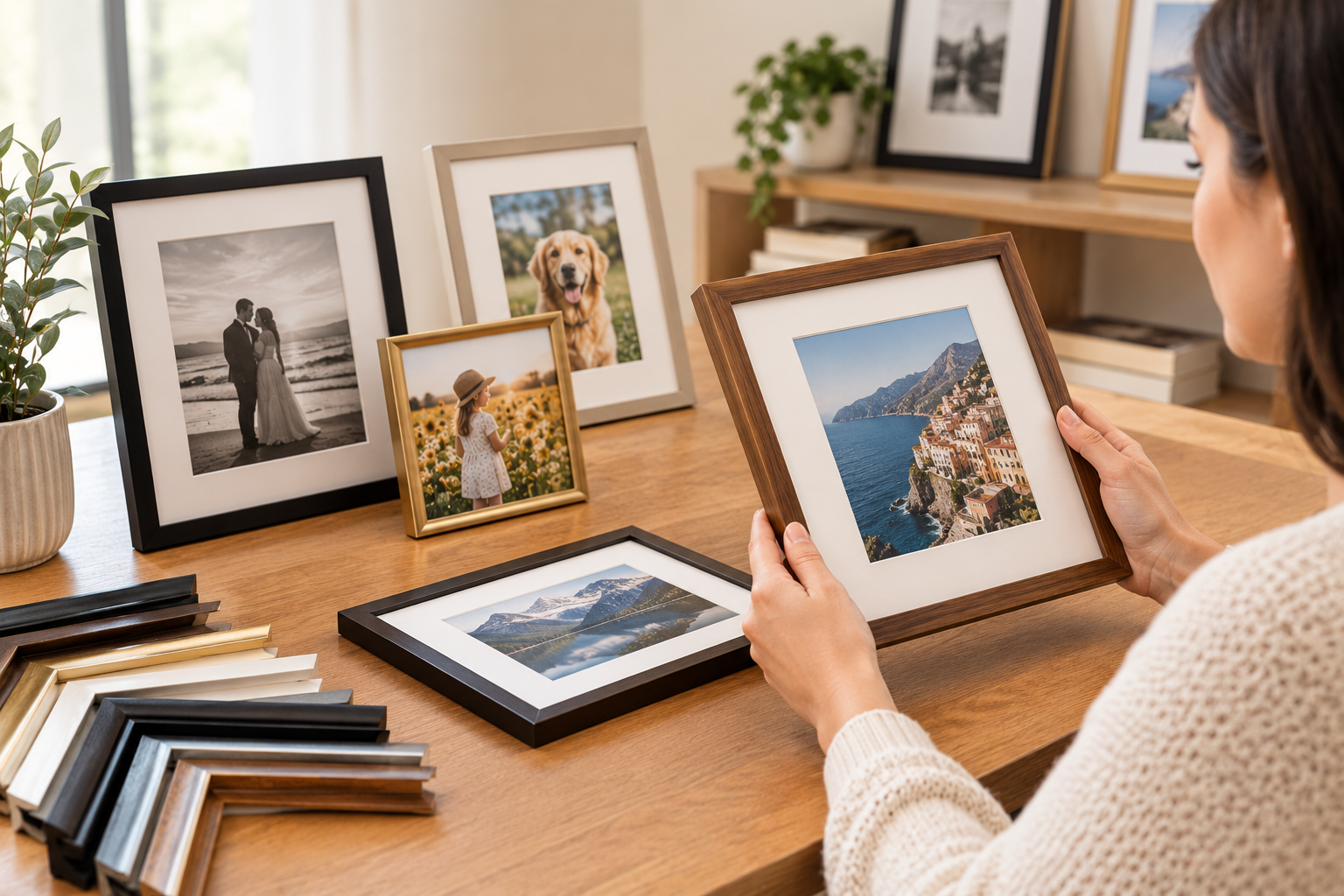
To choose the right frame for any photo, work through five factors in order: what kind of photo it is (casual, professional, vintage or art), what size and aspect ratio it needs, what material and colour suit it, what glazing protects it properly, and where it will hang. Decide in that order, since photo type shapes every choice after it. Online photo framing in Dubai typically lets you set all five in one checkout, with the total price building as you go.
Most framing advice answers one question at a time: what size, what colour, what glass. Useful on their own, but a real photo never arrives with only one question attached. You're choosing size and material and glazing and room fit all at once, and the four separate answers don't always agree with each other.
This is the guide that puts the pieces back together. Five factors, in the order that actually matters, followed by three complete worked examples so you can see the whole decision made from start to finish, not just one slice of it.
Whether you end up ordering from a local shop or choosing online photo frames in Dubai, the same five-factor process applies — this guide works either way.
The 5-Factor Framing Formula
Work through these in sequence rather than jumping to your favourite frame colour first. Each factor narrows the next one.
|
1 |
What Kind of Photo Is It? |
This decides almost everything downstream, so start here.
• Casual or phone photo — check resolution before sizing up past 8x10 or 11x14
• Professional photo — respect the photographer's aspect ratio (often 3:2); custom sizing avoids cropping
• Vintage or inherited photo — treat as fragile; archival materials and UV glazing matter more here
• Art print or poster — usually more flexible on mounting; a mat is optional rather than essential
|
2 |
What Size Does It Need? |
Size follows two things: where it's going and how the photo was shot.
• Desk or shelf — 4x6 or 5x7 inches
• Bedroom or hallway wall — 8x10 to 11x14
• Living room or main wall — 16x20 to 20x24, or larger for open spaces
• Non-standard ratio (panoramic, square, cropped) — use custom sizing rather than cropping further
|
3 |
What Material and Colour Fits? |
Colour should follow the photo's own tone, not the wall behind it.
• Black — modern, high-contrast, black-and-white photography
• Natural wood — warm portraits, traditional or Scandinavian interiors
• White — busy or colourful photos, gallery-style walls
• Metal — architectural, minimalist or contemporary shots
|
4 |
What Glazing Protects It Properly? |
Match protection level to how replaceable the photo actually is.
• Standard glass — everyday prints with no real sentimental weight
• UV-protective glass or acrylic — anything near a window, or meaningful but replaceable
• Conservation or museum glazing — vintage, one-of-a-kind or investment-value photos
• Acrylic over glass — for kids' rooms, high-traffic walls, or anything being shipped
|
5 |
Where Is It Going? |
Room context is the final check, and it can send you back to adjust an earlier factor.
• Sunlit rooms — always upgrade glazing regardless of the photo's value
• High-traffic areas — favour acrylic over glass for safety
• Multiple frames in one space — keep colour and style consistent across the group
• Humid rooms — avoid displaying vintage or archival pieces there at all
Putting It All Together: Three Complete Examples
Here's what happens when all five factors are worked through for three genuinely different photos.
Example A: A Professional Family Portrait for the Living Room
Shot by a hired photographer, going above the sofa in a bright, south-facing room.
|
Photo type |
Professional, 3:2 ratio |
|
Size |
20x24, custom-sized to avoid cropping the 3:2 ratio |
|
Material & colour |
Natural wood, warm undertone to match the portrait's skin tones |
|
Glazing |
UV-protective acrylic — the room gets strong afternoon sun |
|
Room fit |
Single hero piece, no additional frames needed nearby |
Example B: A Phone Photo for a Bedroom Shelf
A favourite holiday snapshot taken on a phone, going on a small shelf.
|
Photo type |
Casual, phone-shot, standard resolution |
|
Size |
5x7 — safely within the phone photo's resolution limit |
|
Material & colour |
White frame, simple, keeps focus on the photo |
|
Glazing |
Standard glass — low light exposure, low replacement risk |
|
Room fit |
One of a small rotating cluster on the shelf |
Example C: A Vintage Inherited Photo for the Hallway
A fragile black-and-white photo from a grandparent, decades old, going in a hallway.
|
Photo type |
Vintage, fragile, already partially faded |
|
Size |
Custom-sized to the original print's exact dimensions |
|
Material & colour |
Black frame, buffered acid-free mat for black-and-white paper |
|
Glazing |
Museum or conservation glazing — near-total UV protection |
|
Room fit |
Away from direct sunlight despite being a hallway; spacer mat used throughout |
A One-Page Decision Checklist
|
Factor |
Your Answer |
|
1. Photo type |
Casual / Professional / Vintage / Art |
|
2. Size needed |
___ x ___ (standard or custom) |
|
3. Material & colour |
___ |
|
4. Glazing |
Standard / UV-protective / Conservation / Museum |
|
5. Room and light |
___ |
Fill this in before you start browsing frames, and the browsing itself takes a fraction of the time.
Keep this checklist handy the next time you're comparing online photo frames — running through all five lines before you open a single product page saves far more time than it costs.
What Happens When You Skip a Factor
• Skip photo type, and you might put standard glazing on a vintage photo that needed UV protection
• Skip size, and you crop a professional 3:2 shot into an ill-fitting 4:5 frame
• Skip material and colour, and the frame fights the photo instead of supporting it
• Skip glazing, and a sun-facing piece fades within a year or two
• Skip room fit, and a single beautiful frame looks lost — or out of place — on the wrong wall
How Online Photo Framing in Dubai Brings All Five Together
A well-built online photo framing checkout mirrors this exact formula: photo type and size first, then material and colour, then glazing, with the total price building as each choice is made. Pickframes structures online custom framing in Dubai this way, so the five factors above map directly onto the order screen rather than staying a mental checklist you have to translate yourself.
1. Identify your photo type from Factor 1
2. Enter your size, using custom sizing for any non-standard ratio
3. Choose material and colour matched to the photo's tone
4. Select glazing based on the photo's value and where it's hanging
5. Confirm the itemised price and order your framing in Dubai for delivery
Frequently Asked Questions
What's the most important factor when choosing a photo frame?
Photo type comes first, since it shapes every decision after it — a vintage photo needs different glazing and matting than a casual phone snapshot, regardless of size or room.
Can one frame style work for every type of photo?
Not reliably. A frame that suits a modern colour photo (thin black metal, standard glazing) often isn't right for a vintage or professional shot, which is why working through all five factors matters more than picking one default style.
How do I choose glazing if I'm not sure how valuable a photo is?
As a rule of thumb, ask whether the photo could be easily reprinted or replaced. If yes, standard or UV-protective glazing is fine. If no — an original, vintage or one-of-a-kind image — lean toward conservation or museum-grade glazing.
Does online photo framing in Dubai let me choose all five factors myself?
Yes. A properly built online custom framing checkout presents photo size, material, colour and glazing as separate, visible choices, letting you apply this same five-factor approach directly during ordering.
What should I do first when framing a new photo?
Identify the photo type before anything else — casual, professional, vintage or art print. That single decision narrows your size, material, and glazing choices immediately, which is far faster than browsing frames first and working backward.
Choosing the right frame for any photo isn't really five separate decisions — it's one decision made in the right order. Start with what kind of photo it is, work through size, material, and glazing in sequence, and check the result against the room it's actually going in. Get that sequence right once, and every photo you frame afterward gets faster to decide on, not harder.