
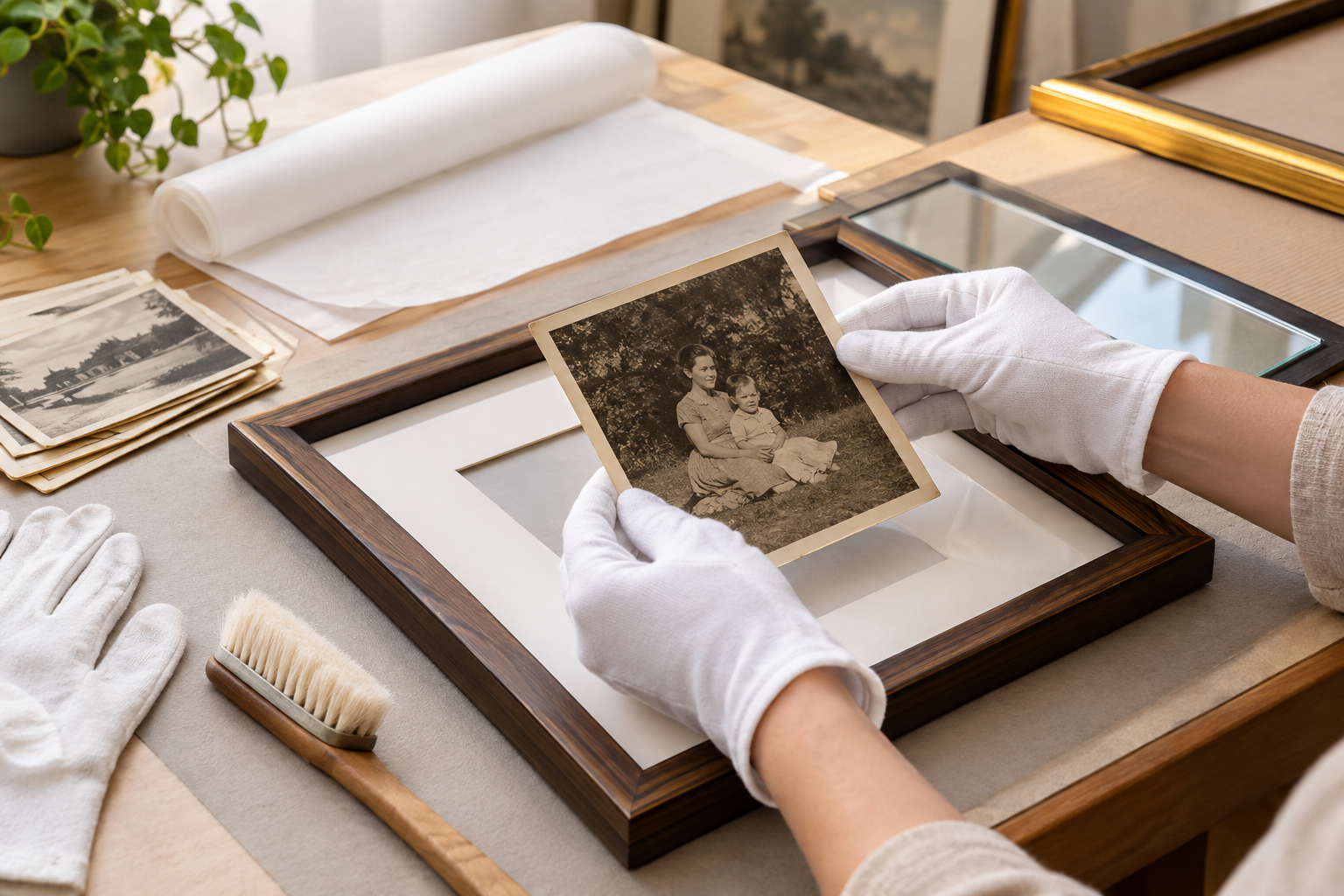
To frame a vintage photo without damage: assess its condition before touching it further, handle it by the edges with clean, dry hands, digitise it with a scan before doing anything else, and use archival, reversible framing materials — acid-free matting, a spacer mat so glazing never touches the surface, and UV-protective glazing, since old photos are already partway faded and further light exposure does the most damage. In Dubai's climate, keep vintage photos away from humid rooms and direct sun. Online photo framing in Dubai can frame the scanned reprint for everyday display while the original stays safely archived.
There is a specific kind of nervousness that comes with picking up a photo older than you are. The corners have gone soft. The surface has a faint sheen it didn't used to have. It came out of an envelope that's been in a drawer for thirty years, and it is, by definition, the only one of its kind.
This guide covers vintage photo frames specifically, alongside the wider photo frames and photo framing advice that applies to any older, fragile print you're trying to protect rather than simply display.
Framing a photo like that is not the same job as framing a photo printed yesterday. The paper is more fragile, the image itself may already be part of the way to fading, and there is no reprint if something goes wrong. This is the careful version of that process, from the moment you pick the photo up to the moment it goes on the wall.
Step 0: Assess Before You Touch It Again
Before scanning, cleaning or framing anything, look closely at what you actually have. The condition of a vintage photo changes what's safe to do with it.
⚠ Brittle or curling paper
What it means: The photographic paper has dried out and lost flexibility, common in photos over 40 to 50 years old.
What to do: Never try to flatten it by force. Let it acclimatise flat under a light weight for a few days before handling further, and support it fully when moving it, rather than picking it up by one corner.
⚠ Silver mirroring (a metallic blue-grey sheen in dark areas)
What it means: A natural ageing process in older black-and-white prints where silver particles migrate to the surface — a sign of age, not damage from mishandling.
What to do: This can't be reversed at home. Digitise the photo as it is; a scan captures the image before mirroring progresses further, and professional restoration can address it separately if desired.
⚠ Tears, creases or missing corners
What it means: Physical damage, often from being carried, mailed or stored loosely for decades.
What to do: Do not tape it, front or back — pressure-sensitive tape stains photographic paper permanently. Support the piece fully in a rigid folder until it can be scanned and professionally framed.
⚠ Foxing (small brown spots) or mould smell
What it means: Foxing is often fungal or caused by impurities in old paper; a musty smell suggests past damp exposure.
What to do: Handle with extra care and store away from humidity immediately. If mould is active (fuzzy texture, spreading), isolate the photo from others and consult a conservator before framing.
The Golden Rule: Digitise Before You Do Anything Else
This is the single most protective step in the entire process, and it's the one most people skip. Scan the photo at high resolution (at least 600 DPI for anything you might want to enlarge later) before cleaning, framing, or even handling it more than necessary.
Once digitised, you have an insurance policy. The original can be archived flat, in acid-free storage, away from light and handling entirely, while a high-quality reprint does the job of actually being displayed, hung, and enjoyed day to day. This single decision removes almost all of the ongoing risk to the original.
Safe Handling Protocol
1. Wash and dry your hands thoroughly, or wear clean cotton gloves for especially fragile prints
2. Work on a clean, flat, dry surface with nothing else on it
3. Support the photo fully with both hands or a rigid backing board — never pick it up by one edge or corner
4. Never use tape, glue, paperclips or rubber bands directly on or near the photo
5. Never laminate a vintage photo — lamination is permanent and traps the print in plastic that can't be safely removed later
6. Store flat in an acid-free folder or sleeve between handling sessions, not loose in a drawer
Archival Framing Techniques for Vintage Photos Specifically
• Photo corners or archival hinging tape on the back only — never adhesive on the visible surface, and never anything permanent
• A spacer mat or float mount so glazing never touches the photo's surface directly, which matters even more with an already-fragile print
• Acid-free, buffered matting for black-and-white prints; unbuffered, neutral-pH matting for colour and some vintage colour processes, which can react differently to alkaline buffering
• UV-protective or museum-grade glazing is close to essential here, since a vintage photo has often already lost some density to fading — protecting what remains matters more than with a fresh print
• Avoid any dry-mounting or permanent adhesive process; vintage photos should always remain removable from their framing
What Not to Do
|
Common Mistake |
Why It Damages a Vintage Photo |
|
Laminating the original |
Permanent, traps moisture, cannot be safely reversed |
|
Taping the photo to a backing board |
Adhesive stains and can tear paper on removal |
|
Displaying it in direct sunlight |
Old photos are already partway faded; further UV exposure accelerates loss |
|
Hanging it in a bathroom or humid kitchen wall |
Humidity encourages mould, foxing and paper warping |
|
Using standard, non-archival mat board |
Acidic board accelerates yellowing and brittleness |
|
Cleaning with water or household cleaners |
Can dissolve emulsion or spread existing damage |
Dubai's Climate and Why It Changes the Calculation
Vintage photographic paper is more sensitive to environmental swings than modern prints, which makes a few Dubai-specific conditions worth planning around:
• Strong, near-constant UV — a bigger threat to an already-faded original than to a fresh, full-density print
• Air-conditioning swings — moving between cold, dry interiors and hot, humid exterior air stresses old, brittle paper more than newer stock
• Occasional high humidity — a real risk for mould and foxing if a vintage photo is stored in an unconditioned space, such as a garage or store room
None of this means a vintage photo can't be displayed in Dubai — it means the digitise-first approach and UV-protective glazing matter more here than in a milder, drier climate.
It also explains why so many families researching framing in Dubai for an inherited photo end up choosing online photo frames rather than a walk-in shop: the process is calmer, there's no rush, and the scan can be reviewed carefully before any physical framing decision is made.
Restore, or Preserve As-Is?
Once digitised, a genuine choice opens up: leave the original exactly as it is, imperfections included, or have it professionally restored (digitally or physically) before reframing. There's no universally correct answer — some families prefer the honesty of visible age, others want the image restored to its original clarity. What matters is making this decision deliberately, after the photo is safely scanned, rather than attempting a DIY fix that can't be undone.
How Online Photo Framing Fits Into This Process
Once a vintage photo is scanned, online photo framing in Dubai becomes genuinely useful: a high-quality reprint of the scan can be custom-framed for everyday display exactly like any other photo, while the fragile original stays archived and largely untouched. This is often the safest long-term setup for a genuinely irreplaceable piece.
1. Assess the photo's condition and handle it minimally using the protocol above
2. Scan at high resolution before any further handling
3. Decide whether the original will also be framed, or archived while a reprint is displayed
4. For framing the reprint, choose custom framing with acid-free matting and UV-protective glazing
5. For the original, if framed, insist on reversible, archival mounting throughout
6. Order online custom framing in Dubai for delivery, keeping the original safely stored separately if not displayed
This same online framing process works whether you're ordering one reprint or several — many families digitise an entire box of vintage photos at once and then order matching online photo frames in Dubai over time as each one is chosen for display.
Frequently Asked Questions
How do I frame an old photo without damaging it further?
Handle it by the edges only, avoid tape or glue on the surface, use acid-free matting with a spacer mat so glazing doesn't touch the photo, and choose UV-protective glazing since vintage photos are often already partway faded.
Should I scan a vintage photo before framing it?
Yes, this is the single most protective step. A high-resolution scan preserves the image permanently, so a reprint can be displayed day to day while the fragile original is archived and rarely handled.
Is it safe to laminate an old family photo to protect it?
No. Lamination is permanent, traps moisture against the print, and cannot be safely reversed. Reversible archival framing methods protect a vintage photo without altering it irreversibly.
What is silver mirroring on an old black-and-white photo?
A natural ageing effect where silver particles migrate to the surface, creating a metallic sheen in darker areas. It's a normal sign of age rather than damage from mishandling, and can't be reversed without professional restoration.
Can online photo framing in Dubai handle a scanned reprint of a vintage photo?
Yes. Once a vintage photo is digitised, online custom framing in Dubai can frame the high-quality reprint for everyday display, using the same archival matting and UV-protective glazing recommended for the original.
A vintage photo deserves more caution than a fresh print, not less framing altogether. Assess its condition, scan it before anything else, handle it minimally, and use reversible, archival materials for whatever does go on the wall. Get those steps right and a photo that's already survived decades has a genuine chance at surviving many more.