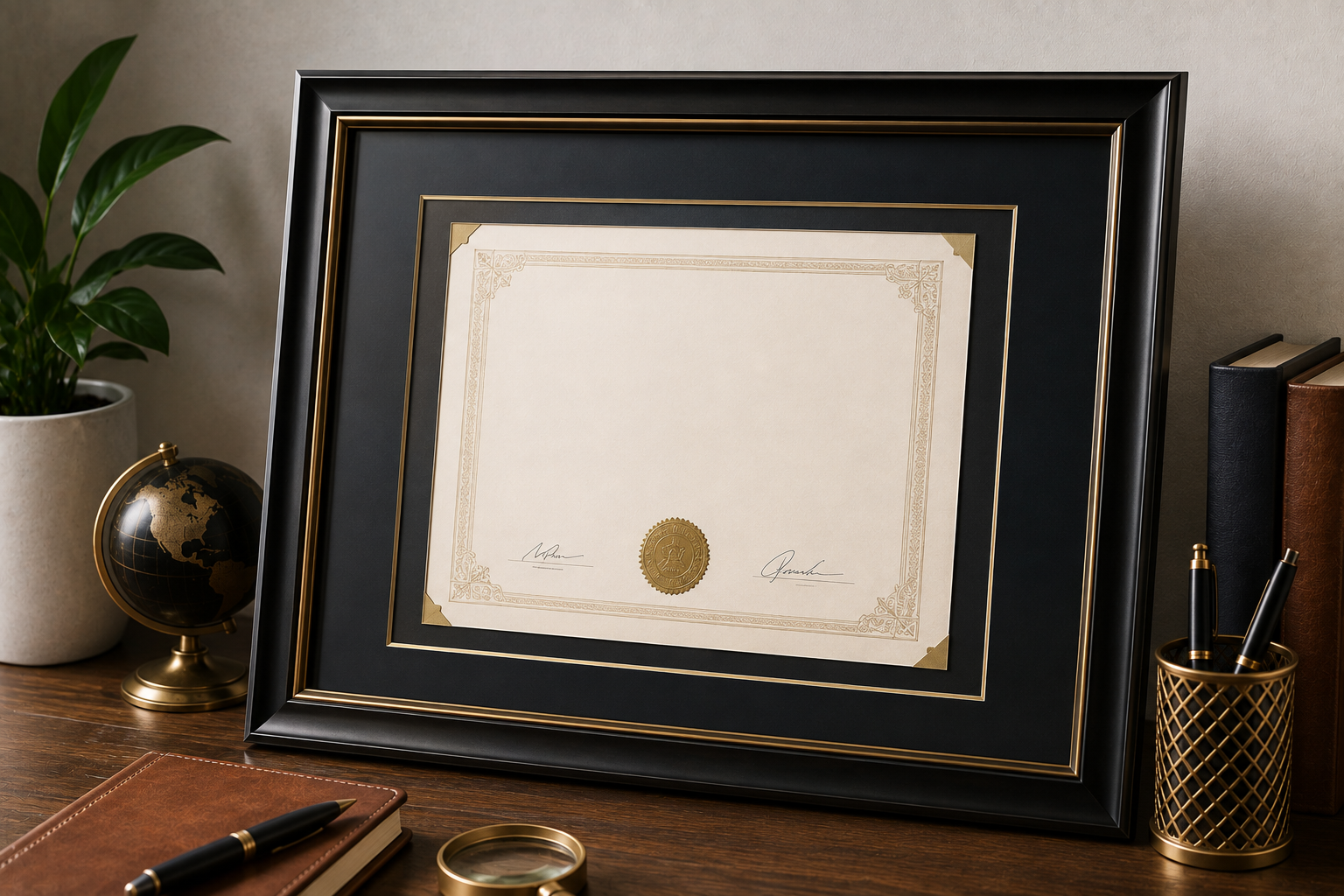
To frame a certificate or diploma correctly, use acid-free matting and backing board, UV-protective glass or acrylic, and a mounting method that doesn't involve glue, tape, or lamination directly on the document — corner mounts or archival hinges are the standard. Avoid direct sunlight when positioning the frame, and choose a frame style (wood, metal, or float-mount) that suits where it will hang, whether that's a home office, a clinic, or a corporate reception area. Professional custom picture frames with archival materials typically cost AED 150–450 in the UAE depending on size and glazing.
A diploma survives four years of effort — or in some cases, decades of career milestones bundled into a stack of certifications — and then it usually ends up rolled inside a cardboard tube in a drawer, slowly curling, yellowing, and getting forgotten. The irony is that most people who eventually do frame it get the framing itself wrong: cheap glass with no UV protection, adhesive mounting that damages the paper permanently, or a frame style that looks more like a supermarket poster than a credential worth displaying. Certificate and diploma framing has its own set of rules, separate from framing an ordinary photo, and getting it wrong isn't always obvious until years later when the ink has faded or the paper has yellowed at the edges.
This guide covers exactly what goes wrong, why it happens, and the correct step-by-step process for certificate framing that actually protects the document instead of slowly damaging it.
5 Mistakes People Make When Framing a Certificate
Mistake 1: Using Regular Glass Instead of UV-Protective Glazing
Standard glass blocks almost none of the UV light that causes ink and paper to fade over time. A certificate hung on a wall that gets any natural light exposure — even indirect daylight from a nearby window — will visibly yellow and fade within a few years under regular glass. UV-protective glass or acrylic is a small cost difference that prevents a permanent, irreversible problem.
Mistake 2: Gluing, Taping, or Laminating the Document
This is the single most damaging mistake, and it's also the most common one done with good intentions. Lamination feels like “protection,” but it's permanent and can't be undone — and it actually accelerates yellowing in many paper types due to chemical reactions with the laminate. Glue and double-sided tape leave residue and cause uneven discoloration around the mounting points within a few years. None of this is reversible once done.
Mistake 3: Using Non-Acid-Free Mount Board
Regular cardboard or standard mat board contains acid that leaches into paper over time, causing the visible brown “burn” line often seen around old framed documents. Acid-free (archival) matting and backing board costs marginally more but is the single biggest factor in whether a certificate still looks crisp in twenty years or has visibly degraded.
Mistake 4: Choosing a Frame Style That Doesn't Match the Setting
A heavy ornate gold frame looks out of place in a minimalist home office, and a plain thin poster frame looks under-dressed in a corporate boardroom or clinic reception. This isn't just aesthetics — mismatched framing style is one of the most common reasons a certificate ends up back in a drawer instead of displayed, because it never quite looked “right” wherever it was hung.
Mistake 5: DIY Framing Without Proper Tools
Standard off-the-shelf poster frames from a general retailer rarely include acid-free components, and DIY mounting at home usually means improvising with whatever adhesive or backing is on hand. A dedicated picture framing service has the archival-grade materials and mounting tools this specific job actually requires — this is one framing task where the DIY route often costs more in the long run through document damage than the professional route costs upfront.
Step-by-Step: How to Frame a Certificate or Diploma the Right Way
1. Inspect and flatten the document first — gently flatten any rolled or folded certificate under light, even pressure (heavy books work) for a day or two. Never force-flatten a brittle or older document.
2. Choose acid-free matting and backing — ask specifically for archival or acid-free mat board and backing when ordering custom picture frames.
3. Select the mounting method — use corner mounts, photo corners, or archival hinging tape on the back edges only, never glue or tape across the face of the document.
4. Choose UV-protective glazing — pick UV-filtering glass or acrylic, especially near windows or strong indoor lighting.
5. Pick a frame style suited to where it's hanging — slim wood or black frames for modern spaces, heavier traditional frames for formal settings.
6. Position away from direct sunlight — even UV-protective glazing won't fully prevent fading under prolonged direct light.
7. For high-value documents, consider a shadow box — ideal when pairing a certificate with a medal, seal, or ribbon.
Framing Materials Compared
|
Component |
Budget Option |
Recommended (Archival) |
Why It Matters |
|
Glazing |
Standard glass |
UV-protective glass or acrylic |
Prevents fading from light exposure |
|
Mat/backing board |
Regular cardboard |
Acid-free (archival) board |
Prevents yellowing and acid burn |
|
Mounting method |
Glue or tape |
Corner mounts / archival hinges |
Non-damaging, fully reversible |
|
Frame material |
Basic plastic/poster frame |
Wood, metal, or float-mount frame |
Better durability and presentation |
|
Document handling |
DIY at home |
Professional framing service |
Reduces risk of tearing or misalignment |
Framing Certificates for the Office: A Bulk Opportunity Worth Knowing About
Certificate framing isn't only a personal, one-off task. Clinics displaying medical licenses, law firms framing bar admissions, real estate offices framing agent certifications, and hotels framing staff awards or hospitality accreditations all need multiple certificates framed consistently — same frame style, same matting, often the same wall. This is where wholesale picture frames and bulk-order framing services become relevant: ordering ten or twenty identical frames as a batch is usually more cost-effective per unit than framing them individually over time, and it guarantees a uniform look across a reception area or hallway. If your workplace has a stack of unframed certifications sitting in a drawer, a single bulk order solves the whole backlog at once.
What Certificate Framing Costs in the UAE
Pricing depends primarily on size, glazing type, and whether matting or a shadow box is involved:
• Standard A4/letter-size certificate, basic frame, standard glass: roughly AED 100–180
• Standard size with acid-free mat and UV-protective glazing: roughly AED 180–300
• Large diploma or oversized certificate, archival materials: roughly AED 250–450
• Certificate + medal or object in a shadow box: roughly AED 300–550
If you're searching for picture framing near me or a custom frame shop near me to get an exact quote, it's worth confirming upfront whether acid-free matting and UV glazing are included by default or charged as an add-on — this affects the real comparison between providers more than the base price alone.
Ordering Certificate Framing Online in the UAE
Most people assume certificate framing has to be done in person because of the handling involved, but reputable online art framing services in Dubai, Abu Dhabi, and Sharjah now offer certificate-specific framing options — you specify the document size, choose archival matting and UV glazing, and either courier the physical certificate to a secure facility or, for reprinted certificates and awards, upload a digital file. Turnaround is typically 5–7 working days for archival framing, slightly longer than standard photo framing due to the extra handling care involved.
Look for a provider that explicitly lists:
• Acid-free / archival matting as a named option, not just “matting”
• UV-protective glass or acrylic as a specified choice
• Secure handling or courier process for physical documents
• Bulk/wholesale pricing for offices ordering multiple frames
A certificate represents real effort — years of study, a professional milestone, an achievement that took work to earn — and it deserves framing that actually protects it rather than slowly damaging it while looking fine on the surface. The difference between a frame that lasts twenty years and one that yellows and fades within five usually comes down to a handful of material choices most people never think to ask about: acid-free board, UV glazing, and a mounting method that doesn't touch the document with glue. Get those right, and the framing becomes as permanent as the achievement it's protecting.
Visit Pickframes.com — Frame Your Achievement. Preserve Your Success.
Frequently Asked Questions
1. What is the best way to frame a certificate or diploma?
Use acid-free matting and backing board, UV-protective glass or acrylic, and a mounting method like corner mounts or archival hinges instead of glue or tape, which can permanently damage the document over time.
2. Does lamination protect a certificate when framing it?
No. Lamination is permanent and can actually accelerate yellowing in some paper types due to chemical reactions with the laminate — archival matting and UV-protective glazing are safer, reversible alternatives.
3. How much does professional certificate framing cost in the UAE?
Standard certificate framing typically costs AED 100–300 depending on size and glazing, while archival framing for large diplomas or certificates paired with a medal in a shadow box can range from AED 250–550.
4. Can I frame multiple certificates together for an office display?
Yes. Matching frame styles across multiple certificates creates a cohesive gallery wall display, and ordering as a wholesale or bulk batch is typically more cost-effective than framing them individually over time.
5. How long does professional certificate framing take?
Archival certificate framing typically takes 5–7 working days due to the extra handling and mounting care required, compared to 3–5 days for standard photo framing.