
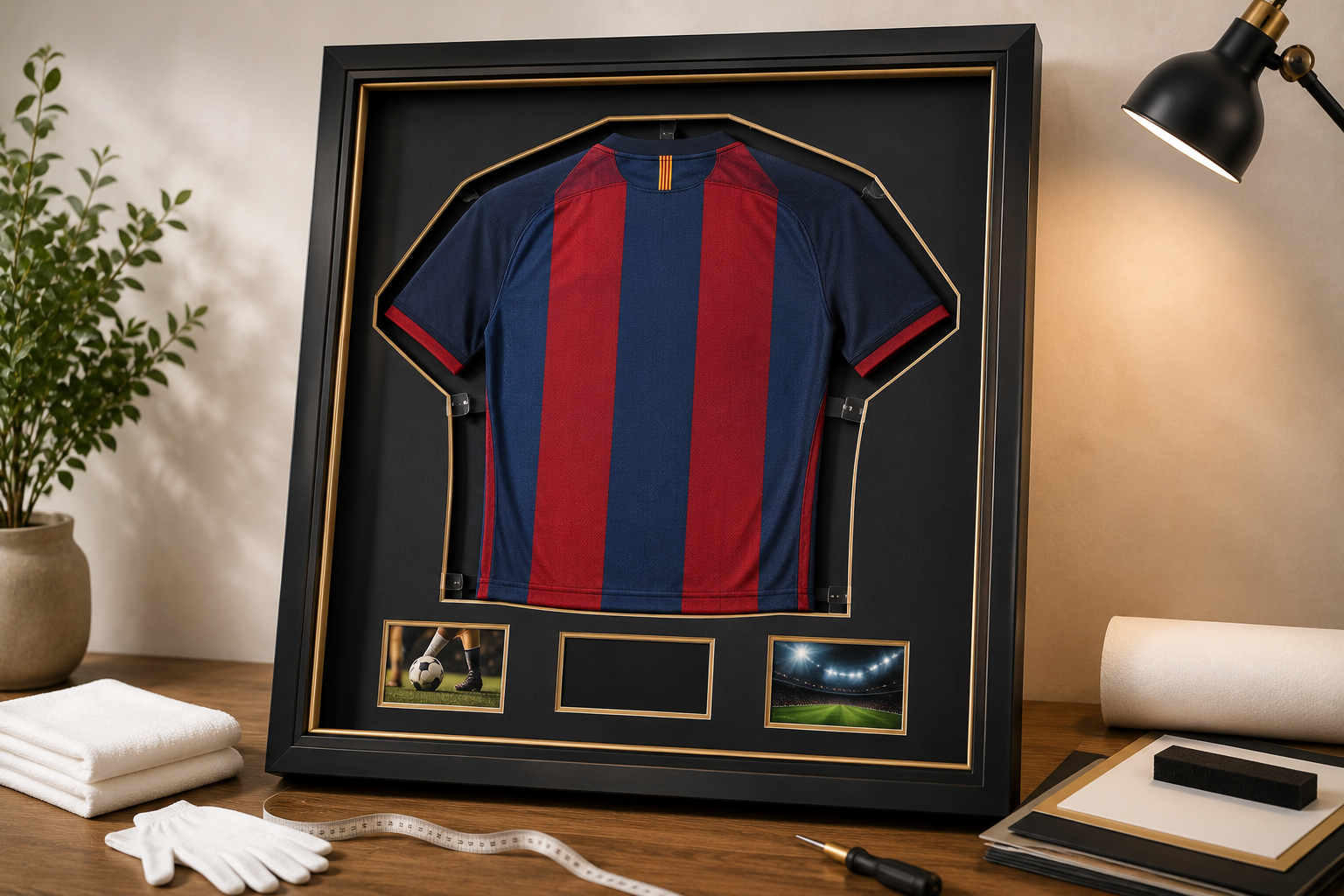
The safest way to frame a football jersey is to mount it using a pin-and-tension or clip-based mounting system inside a deep shadow box frame — never glue, iron-on adhesive, or a stapled backing, all of which cause permanent fabric damage. UV-protective glazing and acid-free backing board prevent fading and discoloration over time. In the UAE, professional jersey framing typically costs AED 350–900 depending on jersey size, mounting complexity, and whether a badge, ball, or photo is included alongside it.
Somewhere in most football fans' homes, there's a jersey that never made it out of the drawer. Maybe it's a signed shirt from a stadium visit, a match-worn piece bought at auction, a gift from a player met once in a lifetime, or simply the shirt from the year your team finally won something. It sits folded, slowly creasing along the same lines, occasionally pulled out to show a friend before going straight back into storage — because framing it feels like a bigger project than it actually is, and there's a real fear of getting it wrong and ruining something that can't be replaced.
That fear is reasonable. Bad jersey framing is common, and unlike a photo, a damaged jersey usually can't be reprinted. But the actual process, done correctly, is far more straightforward than most people assume — and almost all of the damage that happens to framed jerseys comes from a small handful of avoidable mistakes rooted in popular myths about how framing “should” work.
3 Myths About Jersey Framing That Cause the Most Damage
Myth 1: “Ironing it flat first makes it easier to frame.”
This is one of the most common — and most damaging — assumptions. Many jerseys, especially replica and match-worn shirts, use heat-sensitive printing or heat-applied badges and numbers. A direct iron can warp, crack, or partially melt printed graphics, sometimes irreversibly. If a jersey needs flattening, it should be done with light, even pressure over time, not heat.
Myth 2: “Any deep picture frame will work — you just need more space than usual.”
A standard deep frame gives you room, but without a proper mounting system, the jersey inside will sag, shift, or bunch up against the glass over months of gravity and minor vibration (a wall near a door, for example). Jerseys need to be held under gentle, even tension across multiple points, not just laid inside a box — this is the actual function a shadow box frame built for textiles serves, and it's different from a shadow box designed for flat objects like certificates or medals.
Myth 3: “Gluing or stapling the jersey to a backing board keeps it secure.”
This is the single most irreversible mistake possible. Glue seeps through fabric fibers and leaves permanent marks and stiffness. Staples punch physical holes through the material. Neither can be undone, and both permanently reduce the value and integrity of a signed or match-worn jersey. Professional mounting always uses removable, non-penetrating methods — the jersey should be able to come back out of the frame in the same condition it went in.
3 Real Methods for Mounting a Jersey (Compared)
|
Method |
How It Works |
Best For |
Reversible? |
|
Pin/tension mounting |
Jersey is stretched under gentle tension and held with fine pins along the seams and hem, invisible once framed |
Most jerseys, including signed and match-worn pieces |
Yes — fully reversible |
|
Clip or clamp mounting system |
Purpose-made clips grip the fabric edges inside the frame without piercing it |
Heavier jerseys or thicker fabric blends |
Yes — fully reversible |
|
Fabric-safe adhesive strips (limited use) |
Low-tack, archival mounting strips used only on hems, never on printed areas |
Lightweight jerseys with minimal embellishment |
Partially — residue risk if used incorrectly |
Pin/tension and clip mounting are what any reputable picture framing service should be using as standard. If a provider mentions glue, staples, or a standard iron-down adhesive backing for jersey mounting, that's a clear signal to look elsewhere.
What You Actually Need for Proper Jersey Framing
• A deep shadow box frame — enough internal depth to accommodate the fabric's natural thickness without compressing it against the glass
• Acid-free backing board — prevents long-term discoloration where the fabric touches the backing
• UV-protective glass or acrylic — protects printed numbers, names, and any signatures from fading, especially on jerseys displayed near natural light
• A tension or clip mounting kit — the actual mechanism holding the jersey in place without damage
• Optional: a matching badge, ball, or photo mount — for jerseys framed as part of a larger memorabilia display
What Kinds of Jerseys People Frame Most
Signed jerseys from a player meet-and-greet, charity event, or auction — these carry the highest value and the highest stakes for correct handling, since signature ink can also be sensitive to both heat and UV light.
Match-worn or match-issued jerseys — often slightly different in cut or detailing from retail versions, and typically the most valuable pieces people frame, warranting the most careful mounting method.
Retro or retired jerseys — old shirts from a specific season or era, often framed as a nostalgia piece for a home office, man cave, or games room.
Gift jerseys — personalized with a name and number, framed as a birthday or father's day gift rather than tied to a specific match or player.
Youth team or personal jerseys — a child's first match kit, a five-a-side team shirt, or a marathon/charity run jersey, framed for sentimental rather than collectible reasons.
Whatever the category, the mounting principles stay identical — the value of the piece changes how much care and what materials are worth investing in, not the underlying method.
Which Framing Approach Is Right for You?
If the jersey is signed or match-worn: invest in professional pin/tension mounting, UV-protective glazing, and acid-free backing without cutting corners — the goal is full reversibility and long-term preservation, since this piece likely can't be replaced.
If it's a retro or nostalgic jersey with sentimental but not collectible value: the same mounting principles still apply, but you have more flexibility on frame style — a simpler wall frame with a clean mat border works well for a games room or office.
If you're framing a jersey as a gift: consider adding a small engraved plate with a date or occasion, and confirm turnaround time with the framer if it's tied to a specific event like a birthday or retirement.
If you're on a tight budget: clip-mounting in a mid-depth shadow box is usually more affordable than full pin/tension work while still being completely non-damaging — ask specifically for a non-adhesive mounting option rather than defaulting to the cheapest listed service.
What Jersey Framing Costs in the UAE
• Standard jersey, clip-mounted, mid-size shadow box, standard glazing: roughly AED 350–500
• Jersey with UV-protective glazing and acid-free backing: roughly AED 450–650
• Signed or match-worn jersey, pin/tension mounted, museum-grade glazing: roughly AED 600–900
• Jersey framed with badge, ball, or photo insert: roughly AED 700–1,100+
Prices from a general custom frame shop near me search can vary significantly, largely because not every provider offers proper tension or clip mounting as standard — it's worth confirming the exact mounting method before comparing prices, since a cheaper quote using adhesive backing isn't actually a fair comparison to one using reversible mounting.
Ordering Jersey Framing Online in the UAE
Jersey framing is one of the few categories where most people still assume it has to be done entirely in person, but several UAE art framing services now offer courier-based jersey framing — you send the jersey to a secure facility, choose the frame style, mounting method, and glazing online, and receive the finished piece back via delivery. This works especially well across Dubai, Abu Dhabi, and Sharjah, where courier turnaround is fast enough that shipping isn't a meaningful delay compared to drop-off.
Before choosing a provider, confirm:
• The specific mounting method used (pin/tension or clip — not adhesive or staples)
• Whether UV-protective glazing and acid-free backing are included or optional
• Insurance or liability coverage while the jersey is in transit or in the workshop
• Estimated turnaround, typically 7–10 working days for tension-mounted pieces
A jersey holds a specific kind of memory that a photo or certificate doesn't quite replicate — it was worn, it was there, and in the case of a signed or match piece, it physically connects to a moment that can't be recreated. Jersey framing, done properly, turns that memory into something permanently on display instead of permanently folded in a drawer. The method matters more than almost any other framing category, precisely because a mistake here isn't just aesthetic — it's often irreversible. Get the mounting right, and the jersey stays exactly as good as the day it went in.
isit Pickframes.com — Frame the Moment. Preserve the Legacy.
Frequently Asked Questions
1. What is the best way to frame a football jersey without damaging it?
Use a pin-and-tension or clip-based mounting system inside a deep shadow box frame, with UV-protective glazing and acid-free backing board — never glue, iron-on adhesive, or staples, all of which cause permanent fabric damage.
2. Can I iron a jersey flat before framing it?
No. Many jerseys use heat-sensitive printing or heat-applied badges and numbers, and direct ironing can warp, crack, or melt the graphics. Flattening should be done gradually with light, even pressure instead.
3. How much does professional jersey framing cost in the UAE?
Prices typically range from AED 350 for a standard clip-mounted jersey to AED 900+ for a signed or match-worn jersey with pin/tension mounting and museum-grade UV glazing.
4. Is jersey framing reversible if I want to remove the jersey later?
Yes, if mounted correctly. Pin/tension and clip mounting are fully reversible and don't damage the fabric, unlike glue or staples, which cause permanent, irreversible damage.
5. Can I frame a signed jersey along with a photo or match ball?
Yes. Many framers offer combination shadow boxes that hold a jersey alongside a photo, badge, or ball, typically priced from around AED 700 depending on size and materials used.