
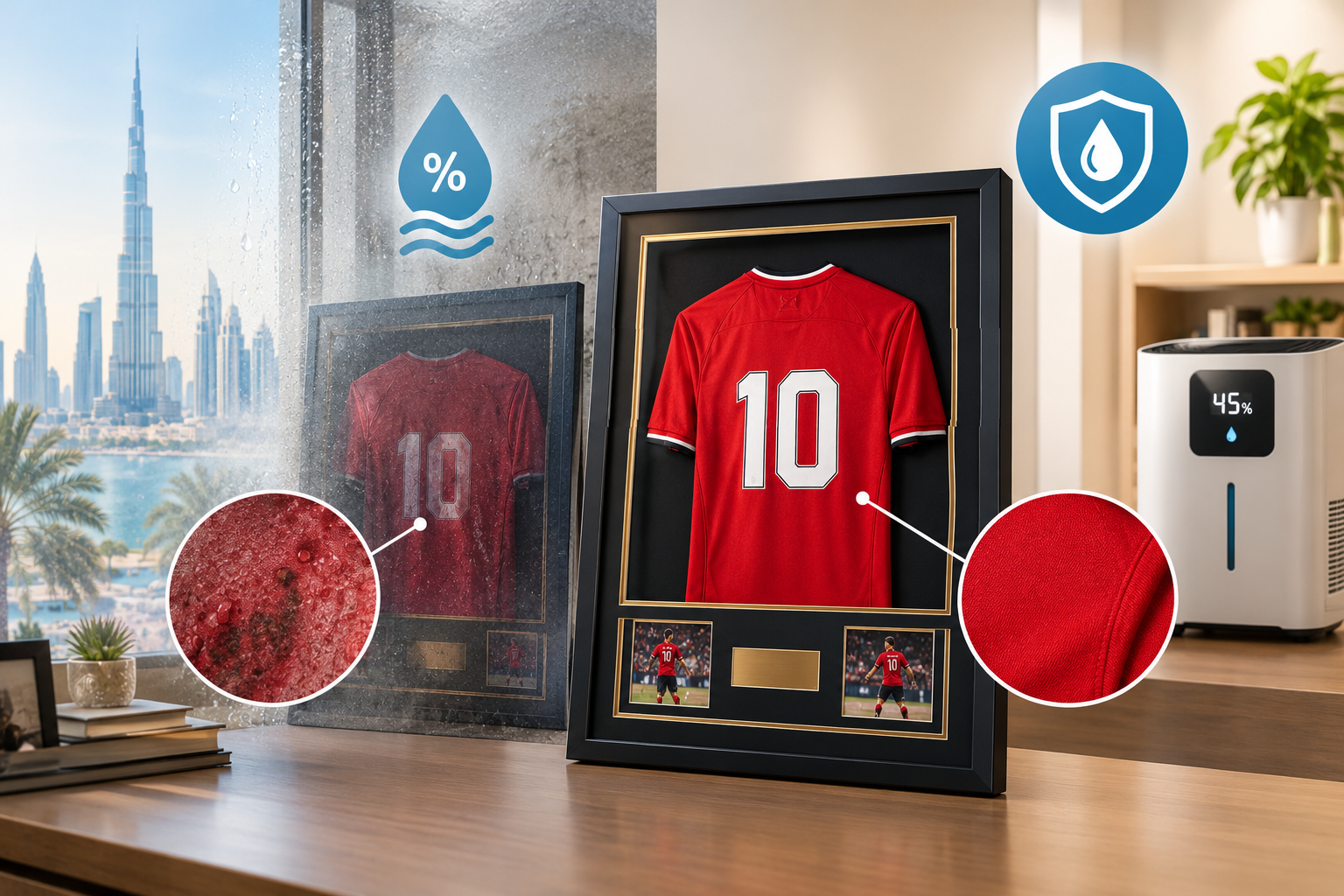
Humidity can harm a framed jersey by encouraging mould and mildew, musty odours, stains, warped frames and board, fogging or condensation inside the glass, and weakened fibres. Dubai’s humid summers, plus cold air conditioning meeting warm, moist air, make this a real risk. To protect a frame, keep it on an interior wall in an air-conditioned room, away from vents, windows, balconies, bathrooms and kitchens, keep the room humidity steady (a hygrometer helps), and choose a well-sealed frame with acid-free materials. If you see fogging, spots or a musty smell, take the frame down and call your framer instead of opening it yourself.
This guide explains how humidity affects framed jerseys in Dubai. It covers what moisture does to fabric, ink and frames, why air conditioning creates its own problems, which parts of a home are riskiest, the warning signs to look for, how to protect a frame and what to do if you find a problem. It is written for anyone who has invested in Jersey/T Shirt framing in Dubai and wants the result to last in this climate.
What Humidity Can Do to a Framed Jersey
|
Effect |
What you might see |
Why it happens |
|
Mould or mildew |
Grey, white, green or black spots; a fuzzy look |
Damp, still air and organic materials |
|
Musty smell |
An odour when you take the frame down |
Moisture trapped in a sealed frame |
|
Fogging inside the glass |
Mist or droplets behind the glass |
Warm, moist air meeting a cooler surface |
|
Staining |
Brown marks or tide lines on the shirt or mount |
Moisture carrying acids from the board |
|
Ink bleeding or transfer |
Signatures that soften, blur or mark the glass |
Damp ink and contact with glazing |
|
Warped frame or backing |
Gaps at the corners, a bowed back or a crooked frame |
Wood and board swelling and drying |
|
Sagging fabric |
A shirt that droops or wrinkles |
Fibres relaxing when damp |
|
Insect activity |
Tiny holes, fine dust or webbing |
Damp, dark conditions |
Most of these can be prevented with a good frame and a good hanging position. All of them are easier to deal with early.
How Different Materials React
• Cotton and cotton blends absorb moisture readily, and can stain, smell and grow mould if they stay damp.
• Wool also absorbs moisture, and can attract insects when damp.
• Polyester and technical fabrics absorb less moisture, but printed numbers, badges and trims can still peel or bleed.
• Signatures in marker or pen can soften or bleed in damp conditions, and transfer to the glass if it touches.
• Foam, rubber or felt badges can become sticky or degrade.
• Wood frames can swell, and glue joints can loosen.
• Cheap, acidic board can stain the shirt, and the effect is worse in damp air.
This is one more reason to choose acid-free materials and proper depth, which our guide on materials used in professional jersey framing explains in more detail.
The Riskiest and Safest Places in a Home
|
Location |
Why |
Risk |
|
Balcony, terrace or porch |
Outdoor humidity, heat and dust |
High; avoid |
|
Bathroom or kitchen |
Steam and cooking vapour |
High; avoid |
|
Wall beside or opposite a window |
Light, heat and condensation on cold glass |
High |
|
Directly under or in front of an AC vent |
Cold air blowing on the frame |
High |
|
Outer walls and damp corners |
Colder walls and moisture |
Medium to high |
|
Storage rooms and garages |
Poor air flow and no cooling |
Medium to high |
|
Interior wall in an air-conditioned room |
Stable temperature and humidity |
Low; best |
|
Study or office with steady cooling |
Consistent conditions |
Low; good |
Our guide on how much space you need on your wall for a framed jersey covers hanging height and spacing, and the one on caring for a framed jersey has a regular check routine.
What About Silica Gel and Other Moisture Absorbers?
It can be tempting to put silica gel packets inside a frame or behind the shirt. Do not do this on your own. Silica gel needs to be the right type, used in the right amount and replaced or recharged, and it can dry some materials too much, or leak dust. Some professional framers use conservation-grade humidity buffers in specific cases, so ask yours whether this is suitable for your piece. For most homes, controlling the room is safer than altering the frame.
What to Do If You Find a Problem
|
Problem |
First step |
Next step |
|
Fogging inside the glass |
Take it down, keep it upright, away from vents and heat |
Contact your framer to open, dry and reseal it |
|
Musty smell |
Move it to a dry, ventilated room, away from other items |
Ask your framer to inspect it |
|
Spots or mould |
Isolate the frame, and do not touch or wipe the shirt |
Contact a framer or textile conservator |
|
Warped frame or backing |
Check the wall and room for damp |
Ask your framer about repair or re-framing |
|
Sagging shirt |
Lay the frame flat to ease the strain |
Ask your framer to re-mount it |
|
Insects |
Isolate the frame, away from other textiles |
Contact your framer or a conservator |
Do not try to dry a shirt with a hairdryer, heater or direct sun, or to clean mould yourself. Heat and rubbing can make things worse. Our guide on what happens if a jersey is damaged during framing explains how to talk to your framer.
Humidity and Signed Jerseys
Signed shirts need extra care in damp air. Ink can soften, bleed or transfer, and the damage cannot be undone. Keep signed jerseys in the most stable, driest part of your home, make sure there is a gap between the glass and the ink, and choose UV-protective glazing too, since light and moisture together are harder on ink than either alone. Our guide on framing a jersey with multiple signatures and the one on protecting a jersey from fading cover this in more detail.
Humidity and T-Shirts
T Shirt framing faces the same risks. A cotton tee is thin and takes up moisture readily, and printed designs can crack, bleed or stick to glass in damp conditions. For T shirt framing in Dubai, choose a sealed frame with acid-free materials and a spacer, and hang it in a stable, air-conditioned room, away from vents and windows.
Choosing a Framer Who Understands the Climate
Not every framer plans for local conditions. When you are comparing studios for Custom Framing in Dubai, ask the following.
• How do you seal the back of the frame?
• Are all boards and mounts acid-free?
• How do you keep the glass off the shirt and ink?
• Do you recommend any protection for humid homes?
• What do I do if I see fogging or a smell, and who do I call?
• What is your guarantee or policy for problems that appear later?
Our guide on how to tell if a framing shop is reputable has a fuller checklist.
Starting With Pickframes
With Pickframes, you choose your jersey type, pick a frame from a wide range of colours and see the price upfront before you order. If you live in Dubai, Abu Dhabi, Sharjah or elsewhere in the UAE, a secure mailer is sent so you can send your shirt to the studio, the estimated delivery is shown at checkout, and there is a happiness guarantee. You can start your jersey framing here, or contact the team if you have a question about protecting a frame in a humid home.
Common Mistakes to Avoid
• Hanging a frame on a balcony, in a bathroom or beside a kitchen.
• Placing it directly in front of an air-conditioning vent.
• Switching the air conditioning off for weeks in summer.
• Carrying a frame straight from a cold room into humid outdoor air.
• Putting silica gel or other absorbers inside the frame.
• Opening the frame to “check” the shirt.
• Ignoring a musty smell or a bit of fog on the glass.
Frequently Asked Questions About Humidity and Framed Jerseys
1. How does humidity affect framed jerseys in Dubai?
Humidity can cause mould and mildew, musty smells, stains, warped frames and board, fogging inside the glass and weakened fibres. Dubai’s humid summers, and cold air conditioning meeting warm, moist air, make this a real risk. A sealed, acid-free frame in a steady, air-conditioned room greatly reduces it.
2. Why is there moisture inside the glass of my framed jersey?
Fogging usually means warm, moist air has met a cooler surface, for example when the frame sits in front of an air-conditioning vent, on a cold outer wall or has been moved from a cold room into humid air. Take the frame down, keep it upright and away from vents, and ask your framer to open, dry and reseal it.
3. Where is the best place to hang a framed jersey in a humid home?
Choose an interior wall in a room that stays air-conditioned, away from windows, vents, balconies, bathrooms and kitchens. Keep the room temperature steady, use a dehumidifier if the room stays damp, and consider a small hygrometer. Conservation guidance often suggests relative humidity of around 45 to 55 per cent.
4. Can humidity damage signatures on a framed jersey?
Yes. Damp air can soften or bleed ink, and signatures can transfer to the glass if it touches. Use a frame with enough depth and spacers to keep the glass off the ink, UV-protective glazing, a sealed back and a stable, dry room. Contact your framer at the first sign of fogging or smell.
5. Does humidity affect T-shirt framing in Dubai too?
Yes. Cotton T-shirts absorb moisture readily, and printed designs can crack, bleed or stick to glass in damp conditions. A sealed frame with acid-free materials and a spacer, hung in a steady, air-conditioned room away from vents and windows, gives the best protection.
Sunlight gets most of the attention, but in Dubai, moisture deserves its share. Choose the right wall, keep the room steady, make sure the frame is sealed and built with acid-free materials, and act early if you see fog, spots or a smell. Whether you chose Jersey Framing in Dubai for a prized signed shirt or Jersey/T Shirt framing in Dubai for a favourite tee, a little attention to humidity protects the shirt, and the good Custom Framing in Dubai that surrounds it.