
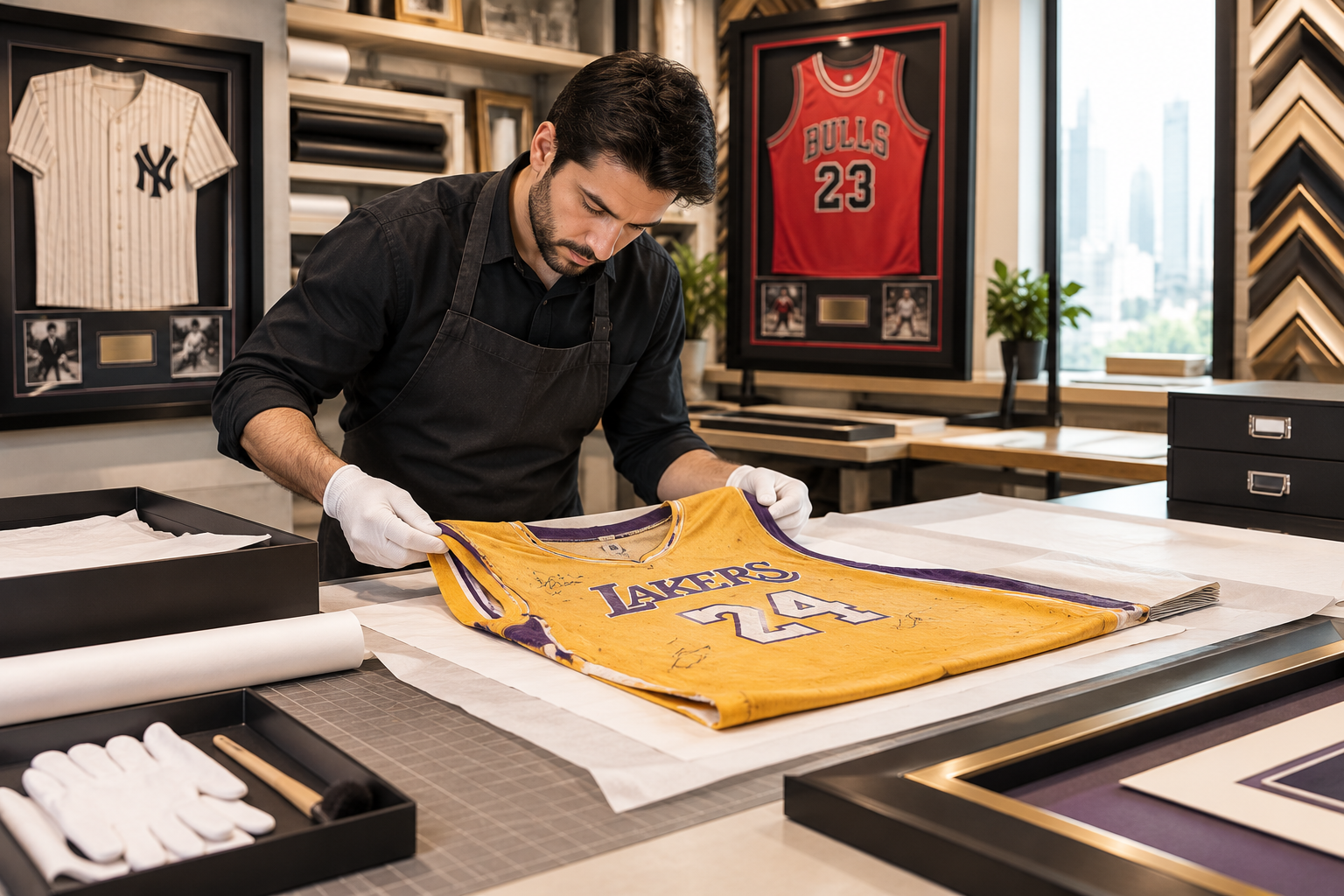
Professional framers treat a vintage or rare jersey as an object to preserve, not just display. They inspect and photograph its condition, record its provenance, avoid washing, ironing and adhesives, and use reversible archival mounting on acid-free, fully supported backing. They add UV-protective or conservation-grade glazing and enough depth to keep the glass off the fabric, and they refer fragile or damaged shirts to a textile conservator first. Published Dubai pricing for jersey framing starts from around AED 250, and rare-item work is normally quoted per project.
Why Vintage Jerseys Need Special Handling
Older materials behave differently, and they have had decades to age.
|
Material or feature |
Common issue with age |
What it means for framing |
|
Wool and wool blends |
Thinning, moth damage, stretching |
Needs full support and gentle handling |
|
Old cotton |
Brittleness, yellowing, stains |
Avoid washing, pressing and strain |
|
Early synthetics |
Stiffening, discolouration, odour |
Needs a stable, inert environment |
|
Felt, rubber or foam badges |
Cracking, crumbling, sticking to other surfaces |
Needs separation from glass and other items |
|
Printed or flocked numbers |
Peeling, cracking, lifting |
No heat or pressure |
|
Embroidered badges |
Frayed threads, loose stitching |
Needs local support, not pulling |
|
Ink signatures |
Fading, bleeding, flaking |
Keep off glass, protect from light |
|
Old repairs or labels |
Weak spots, old glue |
Do not disturb, record and support |
A framer who treats a fragile, 50-year-old shirt like a modern replica can do real harm. That is why experience with textiles matters.
Step 1: Inspect and Record the Condition
Everything starts with a careful look, ideally on a clean, flat, well-lit surface.
• Overall condition: stains, holes, moth damage, odours, brittle areas.
• Weak points: shoulders, seams, collars, cuffs and any previous repairs.
• Badges and numbers: cracks, lifting or loose threads.
• Signatures: where they are, what pen was used and whether the ink is stable.
• Labels and tags: these often help date and authenticate a shirt, and should be kept visible if possible.
The framer will photograph the shirt in detail, front and back, before doing anything else. These photographs protect both of you, and they also become part of the shirt’s record.
Step 2: Record the Provenance
For a rare shirt, the story is part of the value. A good framer will ask about it and help you keep it with the shirt.
• Who wore it, and when and where?
• Who signed it, and how can that be shown?
• Is there a certificate of authenticity, receipt, letter or photograph?
• Has it been cleaned, repaired or altered before?
They may suggest including a small, archival note, a photograph or a plaque in the display. Keep the original documents separately, in a safe place, and give the framer copies.
Step 3: Decide Whether Conservation Comes First
If a shirt is dirty, torn, infested or crumbling, framing alone may not be enough. A responsible framer will tell you so, and may recommend a textile conservator first.
• Do not wash a vintage shirt to “fresh it up”. Washing can destroy dyes, ink and prints.
• Do not iron or steam. Heat can damage fibres and printed numbers.
• Do not use stain removers. They can leave permanent marks.
• Do not repair it yourself. Glue and modern thread can cause damage.
Conservation is specialist work, and sometimes the best result is to stabilise the shirt as it is, with its age showing. Collectors often prefer that to a “restored” look.
Step 4: Build Full Support Behind the Shirt
A fragile shirt should never hang from a few stitches or pins. Its own weight can pull on weak fibres over time. Professionals use a supportive base.
• A fully covered, acid-free backing board or one wrapped in inert, conservation-grade fabric, such as cotton.
• A smooth, even surface under the shirt, so no part hangs unsupported.
• Padding or tissue inside sleeves and the body where shape is needed, so the shirt looks natural without strain.
• A colour that suits the shirt, often a neutral tone for vintage pieces.
Published Dubai specifications for jersey framing mention acid-free mounts and archival pin or stitch mounting, which are the starting point for this level of work.
Step 5: Mount Without Stress, and Without Glue
The mounting method is the most important decision. For vintage and rare shirts, the goal is a fixing that is secure, gentle and fully reversible.
• Archival stitching with fine, inert thread through hems and strong seams, spreading the load, is common for fabric.
• Stainless-steel pins can be used on sturdy areas, but are usually avoided on fragile or signed areas.
• No glue, tape, spray mount or heat-activated adhesive, ever.
• No holes in signatures, prints or badges.
• Stitches placed to avoid visible puckering and to carry the weight evenly.
Everything should be removable by a conservator in the future, without leaving a trace. That principle, called reversibility, is a hallmark of professional work.
Step 6: Protect Against Light
Light is the biggest long-term threat to a vintage jersey. Old dyes and inks are often unstable, and even small amounts of UV can speed up fading.
• UV-protective or conservation-grade glass or acrylic is normally used for rare shirts. Some brands rate their conservation glass at around 99 per cent UV blocking.
• Anti-reflective coatings can make the shirt easier to see.
• Hanging position matters as much as the glass. Choose an interior wall, away from windows.
Our guide on whether custom framing can protect a jersey from fading goes into more detail.
Step 7: Give the Shirt Room, and Keep the Glass Off
Vintage fabric, signatures and cracked prints can all stick to or mark glass. A framer will use a deep box and spacers, so that nothing touches the glazing. Published Dubai specifications for shadow boxes are around 5 to 7 cm deep, and deeper custom boxes are possible. Spacers also leave a small air gap, which helps the shirt breathe.
Step 8: Control the Environment Inside the Frame
Some framers go further to stabilise the conditions inside the frame.
• Sealed backing, so dust, insects and pollutants cannot enter.
• Inert, acid-free materials, to avoid gases and staining.
• Buffered or conservation-grade board, chosen to suit the shirt’s material.
• Moisture control, where appropriate, to help in humid conditions.
In Dubai, where summers are hot and humid and air conditioning is constant, a well-sealed frame and a good hanging position protect the shirt from swings in temperature and moisture. Our guide on caring for a framed jersey explains how to look after it once it is on the wall.
How Rare Items Are Packed and Transported
A vintage shirt should travel as carefully as it is framed.
• Wrapped in clean, acid-free tissue, never in plastic that traps moisture.
• Packed flat or loosely folded, only along existing creases, away from signatures.
• Kept out of heat and direct sun, which matters in Dubai’s summer.
• Sent by a tracked, insured service, or handed over in person.
• Photographed before it leaves you.
If you live in Abu Dhabi, Sharjah or elsewhere in the UAE, ask the studio how they handle rare items by courier, or whether you can deliver it yourself.
How Much Does Rare Jersey Framing Cost?
Published Dubai pricing shows jersey and memorabilia framing from around AED 250, and shadow box framing from around AED 300. A vintage or rare jersey will usually cost more, because of the conservation-grade glass, archival materials, supported mounting, deeper box and extra time. Published Dubai timelines show museum-grade work taking around 5 to 7 days, compared with 3 to 5 for a typical jersey, and rare items may take longer. These pieces are normally quoted per project, so ask for an itemised quote.
What About Vintage T-Shirts?
T Shirt framing for vintage band tees, event shirts and old promotional shirts needs the same care. Old cotton is thin and can tear, and screen prints can crack or stick to glass. A vintage tee should be fully supported, mounted without adhesives and kept off the glazing, with UV protection. For T shirt framing in Dubai, ask about experience with thin, worn fabric.
Questions to Ask a Framer About a Vintage or Rare Jersey
• Have you framed vintage or rare shirts before? Can I see examples?
• How will you assess and record the condition?
• Will you recommend a conservator if needed?
• How will the shirt be supported and mounted, and is it fully reversible?
• What materials will touch the shirt, and are they acid-free and inert?
• What glass do you use, and what UV protection does it give?
• How will it be packed and returned, and what insurance do you have?
• What does the quote include, and how long will it take?
Starting With Pickframes
With Pickframes, you choose your jersey type, pick a frame and see the price upfront before you order. If you live in Dubai, Abu Dhabi, Sharjah or elsewhere in the UAE, a secure mailer is sent so you can send your shirt to the studio, the estimated delivery is shown at checkout, and there is a happiness guarantee. You can start your jersey framing here. For a vintage or rare shirt, contact the team before you order to describe its condition and ask how it would be handled.
Frequently Asked Questions About Framing Vintage or Rare Jerseys
1. How do professional framers handle vintage or rare jerseys?
They inspect and photograph the condition, record the provenance, avoid washing, ironing and adhesives, and use reversible archival mounting on fully supported, acid-free backing. They add UV-protective or conservation-grade glazing, enough depth to keep the glass off the fabric, and refer fragile or damaged shirts to a textile conservator first.
2. Should I wash or restore a vintage jersey before framing it?
No. Washing, ironing, steaming and stain removers can destroy dyes, inks, prints and fibres. If a shirt is dirty, torn or infested, ask a framer or textile conservator for advice first. Often the best approach is to stabilise the shirt as it is, with its age showing.
3. Can a fragile vintage jersey be framed safely?
Usually yes, if it is fully supported and mounted reversibly without strain. A framer will spread the weight on a covered, acid-free backing, use archival stitching in strong areas and keep the glass off the fabric. Very damaged shirts may need conservation first, so describe the condition honestly.
4. How much does it cost to frame a rare jersey in Dubai?
Published Dubai pricing shows jersey and memorabilia framing from around AED 250 and shadow box framing from around AED 300, based on one framer’s price list. Rare or vintage jerseys cost more because of conservation-grade glass, archival materials, supported mounting and extra time, and are usually quoted per project.
5. Does vintage T-shirt framing in Dubai need special care?
Yes. Old cotton T-shirts are thin and can tear, and prints can crack or stick to glass. They need full support, adhesive-free mounting, spacers to keep them off the glazing and UV protection. Ask the framer about experience with fragile fabric before you hand it over.
Framing a vintage or rare jersey is about preservation first and display second. The best framers assess the shirt before they touch it, protect its story, support it fully, mount it reversibly, shield it from light and tell you honestly when conservation comes first. Whether you are arranging Jersey Framing in Dubai for a one-of-a-kind match shirt or Jersey/T Shirt framing in Dubai for a treasured vintage tee, good Custom Framing in Dubai should leave the shirt in as good a condition as it arrived, and ready for the next generation to enjoy.