
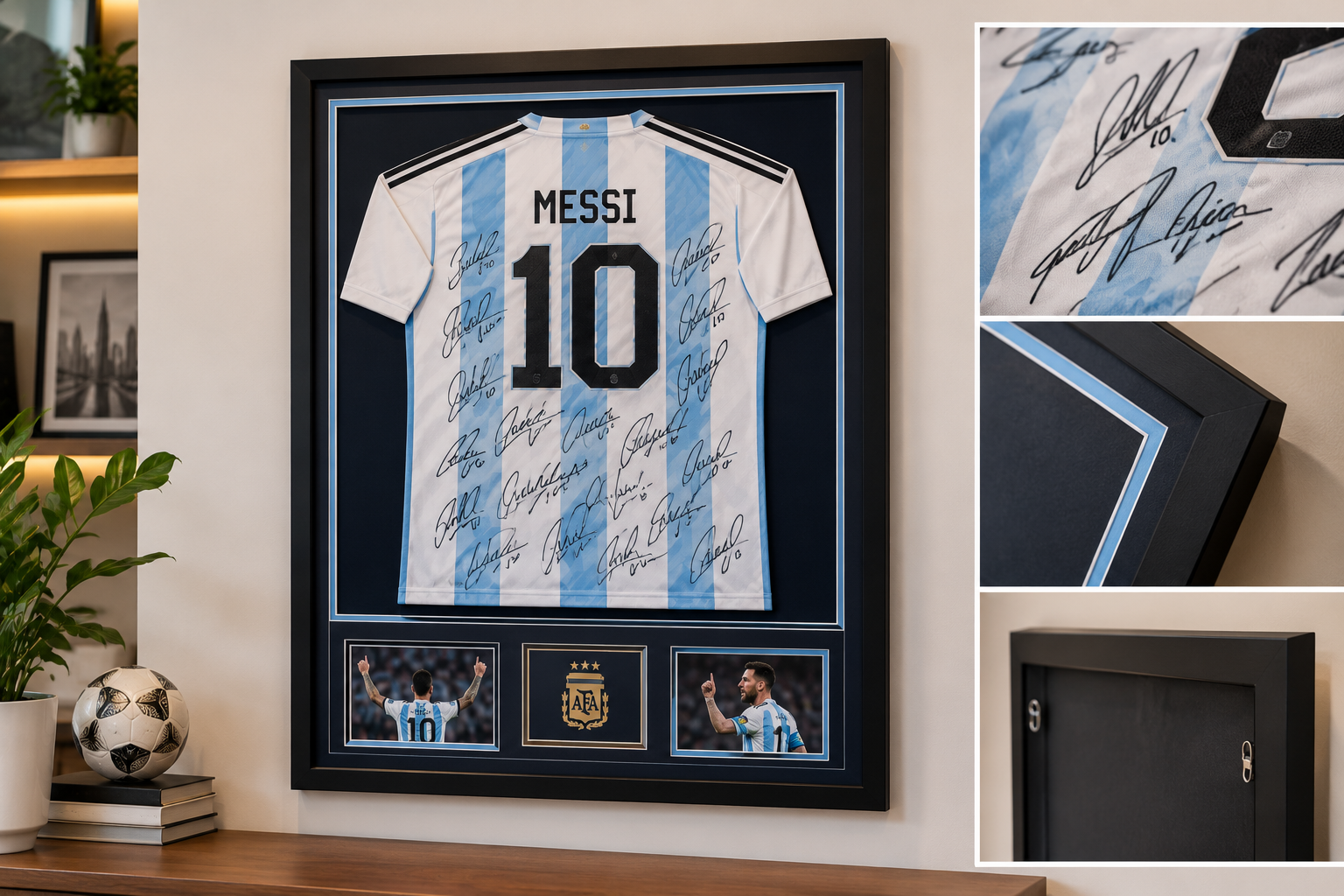
To frame a jersey with multiple signatures, first map every signature and decide which side and area must show. Then choose a layout that keeps all of them visible, usually a large, deep shadow box with the shirt laid flat or an open, unfolded display rather than a tight fold. Use reversible archival mounting, acid-free materials and UV-protective glass, and keep the glass off the ink. Add an engraved plaque or printed key naming the signers. Multi-signature layouts are normally quoted per project, while simple jersey framing in Dubai starts from around AED 250.
A jersey signed by one player is a keepsake. A jersey signed by a whole squad, a band, a class or a group of colleagues is a record of a moment that cannot be repeated. It is also a much harder framing job. Signatures cover the front, back and sleeves, they overlap, they are written in different pens, and a single careless fold can hide half of them.
This guide shows how to plan a multi-signature display so that every autograph stays visible, protected and meaningful. It covers mapping the signatures, choosing a layout, protecting different inks, adding a key so future viewers know who signed, and what to ask a framer. It is written for anyone arranging Jersey/T Shirt framing in Dubai, where strong sunlight makes protection even more important.
Step 1: Make a Signature Map Before Anything Else
The biggest mistake with a team-signed shirt is deciding on the frame first. Start with the shirt itself.
1. Lay the jersey flat on a clean, light surface in good light, front and back.
2. Photograph both sides in high resolution, close enough to read names.
3. Mark every signature on a printout or sketch, numbering them. Note who signed each one, if you know.
4. Note the placement. Which signatures are on the front, back, sleeves, hem or collar? Which cross seams, numbers or folds?
5. Identify the priority signatures. Decide which ones must be visible no matter what, such as a captain, a key player or the one with the most personal meaning.
6. Record the details. Write down when and where it was signed, and keep any certificate or photos of the signing.
Share this map with your framer. It lets them plan the layout around your signatures instead of discovering them halfway through the job.
Step 2: Decide What Needs to Be Visible
A jersey has two sides, but a frame has one front. If signatures cover both sides, you have to choose.
• Front only. The simplest option when most signatures are on the front.
• Front and back, shown separately. A larger display with the shirt opened out or two panels side by side.
• Both sides in two frames. A matched pair, one showing the front and one showing the back.
• A rotating display. A frame with a removable back, so the shirt can be turned, though this needs careful handling each time.
A framer who understands multi-signature jerseys will talk through these options with you instead of defaulting to a standard fold.
Step 3: Choose a Layout That Keeps Signatures Visible
|
Layout |
How it works |
Best for |
Watch out for |
|
Flat, fully open |
The jersey is laid out flat with sleeves spread, so most signatures are visible |
Team and squad signatures spread across the shirt |
Needs a large frame, which costs more |
|
Folded shadow box |
The jersey is folded to show the front and key area in a smaller frame |
A few signatures on the front |
Folds can hide or crease signatures |
|
Signature cut-outs |
Mount windows are cut to reveal specific autographs |
Highlighting priority signatures |
Cut edges must not clip the ink |
|
Front-and-back pair |
Two matching frames show each side |
Jerseys signed on both sides |
Needs two frames and more wall space |
|
Tribute layout |
Shirt plus team photo, crest and a plaque listing signers |
Squad and event keepsakes |
Keep the shirt as the hero |
For a shirt signed by many people, a larger, deeper frame with the jersey laid as flat as possible usually gives the best result. It takes more space and costs more, but it avoids hiding signatures behind folds.
Step 4: Protect Different Inks
Multiple signatures often mean multiple pens. Permanent markers, paint pens, metallic pens and ballpoints behave differently, and some fade or smudge more than others.
• Do not touch the ink. Skin oils and rubbing can smear signatures, especially fresh ones.
• Allow fresh ink to dry fully before handling, folding or framing.
• Keep the glass off the ink. Use a deep frame or spacer, because ink pressed against glazing can transfer or smudge over time.
• Use UV-protective glass or acrylic. Ink can fade with light exposure, sometimes faster than the fabric. Conservation-grade glass is rated by some brands to block around 99 per cent of UV, which suits valuable pieces.
• Never trace over or “refresh” faded signatures. It reduces authenticity and value.
• Test nothing on the signatures. Do not try cleaning, steaming or ironing over them.
If you are unsure about a particular ink, such as a metallic pen on dark fabric, tell the framer. They can decide how to support and shield that area.
Step 5: Mount Without Hiding or Harming Anything
Mounting is where multi-signature jerseys are won or lost. Archival stitching or stainless-steel pins hold the shirt without adhesive, but their placement matters.
• Place stitches and pins in hems and seams, and away from signatures.
• Avoid pins through signed areas. A tiny hole through an autograph is permanent.
• Support the sleeves. If signatures run down the arms, the sleeves need padding or backing so they lie flat without strain.
• Smooth, do not iron. Use gentle methods around signed areas, and avoid heat on printed numbers.
• Keep everything reversible. No glue, tape or dry mounting.
Dubai framers describe their methods as archival pin or stitch mounting for good reason. Ask exactly how the shirt will be held, and where the fixings will go.
Step 6: Add a Key So Everyone Knows Who Signed
Signatures can be hard to read, and after a few years even the owner may forget whose is whose. A key turns a signed shirt into a documented piece.
• An engraved metal plaque naming the team, event and date.
• A printed key beside the shirt, with numbered names matching your signature map.
• A team photo from the event, so signers can be matched to faces.
• A short caption with the match, venue and result, if it is a sports jersey.
A key also helps with value. If the jersey is ever sold, insured or passed on, a clear record of who signed and when is as important as the signatures themselves.
Step 7: Document and Insure
Before the shirt goes into the frame, photograph both sides in high resolution. Keep the photographs, any certificate of authenticity, receipts and notes about the signing in a safe place away from the frame. If the jersey has real value, ask your insurer whether it should be listed separately. None of this changes how the frame looks, but it protects the piece and its story.
Where and How to Hang a Multi-Signature Jersey
• Choose an interior wall away from windows and direct sun. In Dubai, even indirect light adds up over time.
• Use soft, cool LED lighting rather than hot spotlights close to the frame.
• Plan for size and weight. A large, deep frame needs proper wall fixings, not a light picture hook. Ask your framer what hardware is supplied and whether installation is offered.
• Hang at eye level, so signatures are easy to read without standing on tiptoe.
• Avoid damp areas and air-conditioning vents, where temperature and humidity swing.
What About Signed T-Shirts?
T shirt framing with multiple signatures follows the same planning steps, and it is often easier. A cotton tee is thinner, can be laid flat, and may fit a shallower frame, so signatures across the front are simpler to keep visible. Event and tour T-shirts signed by a group, for example at a charity run, a school leavers’ day or a concert, work well in a clean, open layout. Printed designs still need care, and signatures should be protected from light and contact. T shirt framing in Dubai for a signed tee should use the same UV protection and acid-free materials as a jersey.
How Much Does It Cost?
Multi-signature framing is usually quoted per project, because the size, depth, glass and layout vary so much. As a baseline, published Dubai pricing shows jersey and memorabilia framing from around AED 250 and shadow box framing from around AED 300. Expect more for a large flat layout, museum-grade glass, a custom plaque or a paired front-and-back display. If you need to prioritise, spend first on mounting, UV glass and depth, and then on decoration.
Mail-In Framing for Team-Signed Jerseys
If you live in Abu Dhabi, Sharjah or elsewhere in the UAE, carrying a signed jersey across emirates is a risk. With Pickframes, you choose your jersey type, pick a frame, and receive a secure mailer to send the shirt to the studio. You can start your jersey framing here. Before sending a multi-signature shirt, photograph both sides, include your signature map and notes, fold it only along natural lines that avoid signatures, wrap it in clean tissue, and keep the parcel out of heat and sunlight.
Mistakes to Avoid
• Folding the jersey so tightly that signatures are hidden or creased.
• Pinning or stitching through a signature.
• Using glue, tape or spray adhesive anywhere near the shirt.
• Choosing a shallow frame so the glass touches the ink.
• Skipping UV protection in a sunny city.
• Hanging the frame opposite a window.
• Forgetting to record who signed and when.
Frequently Asked Questions About Framing a Jersey With Multiple Signatures
1. How do I frame a jersey with multiple signatures?
Start by mapping every signature on the front, back and sleeves, then choose a layout that keeps them visible, usually a large, deep shadow box with the shirt laid as flat as possible. Use reversible archival mounting, acid-free materials and UV-protective glass, keep the glass off the ink, and add a plaque or key naming the signers.
2. Can all the signatures on a jersey be displayed?
Often yes, but it depends on where they are. If signatures cover both sides, you may need a front-and-back pair of frames, an opened-out layout or a rotating display. A framer can use signature cut-outs to highlight priority autographs. Share a signature map early so they can plan the layout.
3. Will framing damage the signatures?
Not if it is done properly. A good framer holds the shirt with stitches or pins placed away from the ink, avoids adhesives, keeps the glass off the signatures and uses UV-protective glass. Damage usually comes from folding across ink, pinning through autographs, glue or tape, and strong sunlight.
4. How much does it cost to frame a jersey with multiple signatures in Dubai?
Jersey framing in Dubai starts from around AED 250 and shadow box framing from around AED 300, based on one framer’s published prices. Multi-signature layouts are normally quoted per project, because the size, depth, glass and extras such as plaques or photos vary. Ask for an itemised quote.
5. Is T-shirt framing in Dubai different when it has several signatures?
The planning is the same: map the signatures, keep them visible, protect the ink and use reversible mounting. Cotton T-shirts are thinner and easier to lay flat, so they can often fit a shallower frame. Printed designs and group signatures still need UV-protective glass and careful handling.
A jersey with many signatures deserves a plan, not a standard frame. Map the signatures first, choose a layout that shows the ones that matter, keep every fixing away from the ink, protect it with UV glass, and add a key so the story stays attached to the shirt. Whether you are arranging Jersey Framing for a team-signed collector’s piece or T shirt framing in Dubai for a group-signed tee, a careful layout means every name stays visible for years to come.