
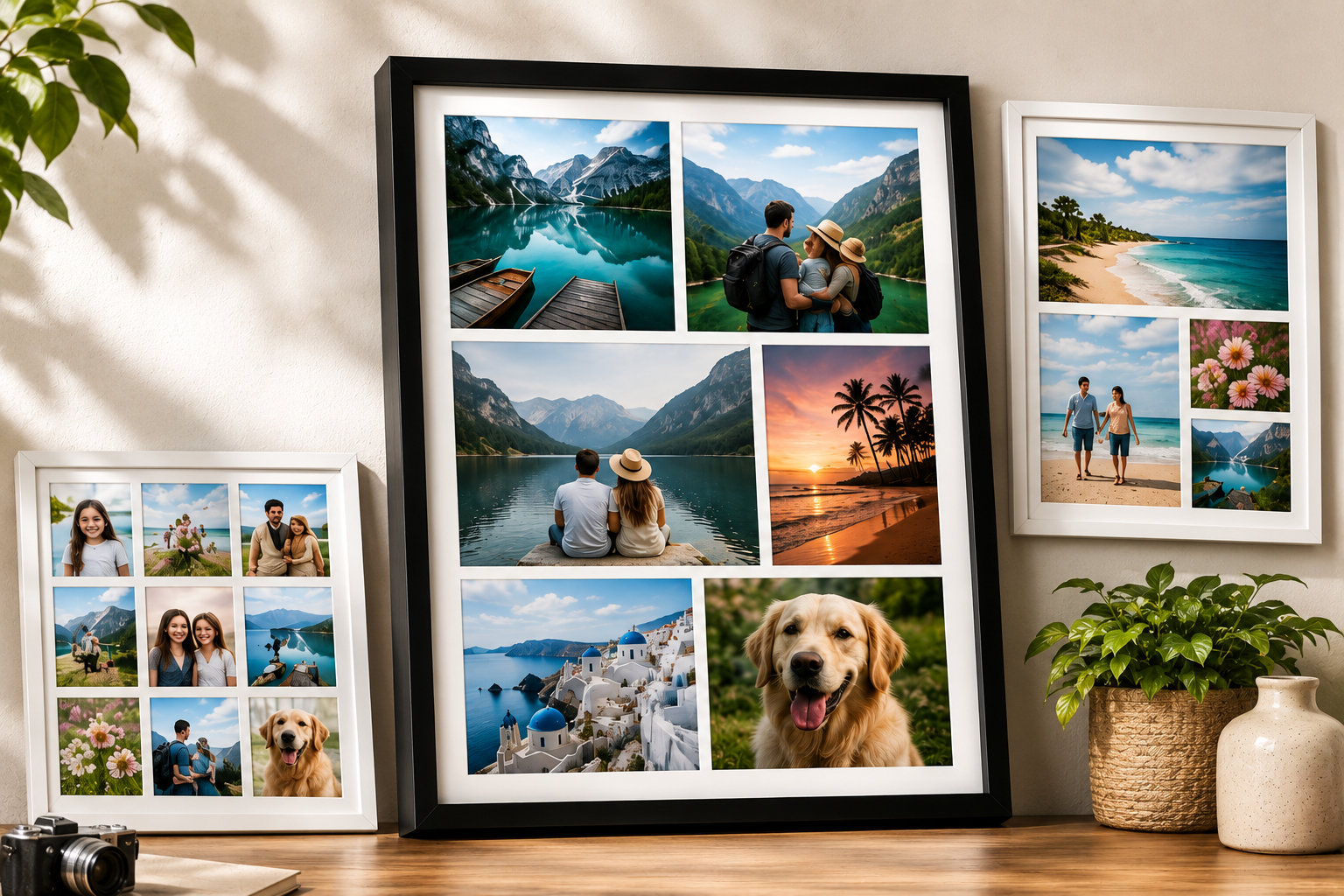
Standard collage frames usually hold between 3 and 20 photos, depending on the frame size and the number of "openings" it's built with. A small 4-opening collage frame typically fits four 4x6-inch photos, a mid-size 9-opening frame fits nine 4x6 or 5x7 photos, and a large gallery-style collage frame (20x30 inches or bigger) can display 12 to 20 mixed-size photos. The exact count always comes down to three things: the overall frame dimensions, the size of each individual photo opening, and how much matting or spacing sits between photos.
Why 'How Many Photos Fit?' Is the First Question You Should Ask
Here's a scene that plays out in frame shops every single day: someone walks in holding a stack of twelve printed photos and a Pinterest screenshot, and asks for "a frame like this one." Ten minutes later, they discover the frame in the photo only holds six openings — and now they're either editing down their favorite memories or buying a second frame they didn't plan for.
Collage frames are one of the most popular ways to display family photos, wedding memories, travel shots, or a baby's first year — but they're also one of the most misunderstood products in the picture-framing world. Unlike a single picture frame, where the math is simple (one photo, one opening), a collage frame is really a small design project: you're balancing frame size, photo count, spacing, and visual flow all at once.
This guide breaks it down properly. By the end, you'll know exactly how many photos fit into every standard collage frame size, which layout suits your space, what it typically costs to buy or customize one, and how to avoid the sizing mistakes that trip up most first-time buyers.
What Exactly Is a Collage Frame?
A collage frame (sometimes called a multi-opening frame or a gallery frame) is a single frame — or a connected set of frames — designed to display more than one photo at once, arranged behind a single mat or across a coordinated group of openings.
There are generally three formats sold under the "collage frame" name:
• Single-mat multi-opening frames — one solid frame with a pre-cut mat containing several photo windows (the most common type you'll find in stores).
• Connected panel frames — individual frames joined by a shared border or hinge, often used for 3-photo or 5-photo sets.
• Gallery wall sets — a curated group of separate frames in different sizes, hung together to form a collage effect on the wall, rather than housed in one physical frame.
Each format changes how many photos you can realistically fit and how flexible the layout is — which is exactly what we'll map out next.
The Photo Count Cheat Sheet: Frame Size vs. Number of Photos
This is the table most people are actually looking for. It maps standard collage frame sizes to the number of photos they typically hold and the most common individual photo size used in that layout. Treat these as industry-standard defaults — custom framing can always adjust the opening count and sizing to your exact photos.
|
Overall Frame Size |
Typical Photo Count |
Common Individual Photo Size |
Best Suited For |
|
8x10 in |
2 – 3 photos |
3x3 or 3x5 in |
Desk, shelf, small hallway nook |
|
11x14 in |
4 photos |
4x6 in |
Bedroom wall, bathroom gallery |
|
12x18 in |
5 – 6 photos |
4x6 in |
Staircase wall, entryway |
|
16x20 in |
9 photos |
4x6 or 4x4 in |
Living room feature wall |
|
18x24 in |
10 – 12 photos |
4x6 in (mixed with a few 5x7) |
Family room, home office |
|
20x30 in |
12 – 16 photos |
4x6 and 5x7 mixed |
Large living room, above sofa |
|
24x36 in and above |
16 – 20+ photos |
Mixed sizes (3x3 to 8x10) |
Statement wall, office lobby, studio |
A quick rule of thumb: as frame size roughly doubles, photo capacity roughly triples — because spacing and mat borders take up proportionally less room on larger frames, letting more openings fit efficiently.
Popular Collage Layouts, Explained
The 3-Photo Layout — Simple and Story-Driven
Three photos in a row (or a triangle) is the easiest layout to get right because there's no complex grid math involved. It works best for a clear "before, during, after" story — a couple's engagement, wedding, and anniversary photo, for example, or three generations of a family.
The 4-Photo Grid — The Safe, Balanced Choice
A 2x2 grid is the most forgiving layout for beginners. It's symmetrical, it's easy to source photos for (four similar-orientation shots), and it fits almost any wall space without overwhelming it.
The 5 to 9-Photo Layout — The Family Favorite
This range is the sweet spot for most households. It's large enough to tell a real story — a year of holidays, a child's first five birthdays, a pet's growth — without requiring you to hunt down a huge number of well-matched photos.
The 12+ Photo Statement Wall
These large-format collage frames or gallery wall sets are less about individual photos and more about the overall visual pattern they create. They work best when photos share a consistent color treatment (all black-and-white, or all warm-toned) so the wall reads as one cohesive piece rather than a cluttered scrapbook.
5 Factors That Actually Determine How Many Photos Fit
The cheat sheet above covers standard sizing, but custom framing gives you room to adjust. Here's what changes the math:
1. Mat width — a wider mat border between photos looks more premium but reduces total photo count for the same frame size.
2. Photo orientation — mixing portrait and landscape photos in one layout is possible, but it usually reduces the maximum count compared to a uniform-orientation grid.
3. Frame depth and moulding width — a thicker frame moulding eats into usable wall space without adding photo capacity, so factor it into your size choice.
4. Uniform vs. mixed photo sizes — layouts using one consistent photo size (all 4x6, for example) fit more photos per square inch than mixed-size collages.
5. Spacing style — tight "puzzle-piece" layouts with minimal gaps fit noticeably more photos than airy layouts with generous white space around each image.
Collage Frame vs. Individual Frames vs. Gallery Wall: Which Should You Choose?
|
Option |
Photo Count |
Effort to Hang |
Best For |
|
Single collage frame |
3 – 20 in one unit |
Low — one hanging point |
Renters, quick setup, gifting |
|
Individual matching frames |
Unlimited, added over time |
Medium — multiple points, needs planning |
Growing collections, evolving families |
|
Curated gallery wall set |
8 – 20+, mixed sizes |
High — needs layout planning |
Statement walls, design-led homes |
2026 Design Trends in Collage Framing
Framing styles shift with interior design trends just like furniture and paint colors do. Here's what's popular in collage and picture framing right now:
• Mixed-media collages — combining photo prints with a small canvas print or a piece of memorabilia (a ticket stub, a pressed flower) within the same collage layout.
• Warm, natural frame tones — oak, walnut, and matte black are outpacing glossy white and silver for collage frames this year.
• Asymmetrical "puzzle" grids — irregular photo shapes fitted together like a puzzle, replacing the strict grid look of previous years.
• Black-and-white or single-tone collections — many households are choosing one color treatment across all photos in a large collage for a cleaner, more gallery-like finish.
• Thin floating mats — a slim, off-white mat with a shadow-gap effect that makes each photo look like it's floating slightly off the backing.
Picture Framing Cost: What Should You Budget for a Collage Frame?
Pricing for collage frames depends on overall size, photo count, frame material, and whether you're buying ready-made or ordering custom framing. As a general market guide:
|
Frame Type |
Typical Price Range* |
|
Ready-made 4 to 6-opening collage frame (small/medium, standard materials) |
Budget to mid-range |
|
Custom-built collage frame, 9 to 12 openings, standard moulding |
Mid-range |
|
Large-format collage frame (16+ openings) or premium moulding/glass |
Mid to premium range |
|
Add-ons: UV-protective glass, museum matting, engraving |
Adds to base price per option |
*Exact picture framing prices vary by shop, materials, and location — always confirm current pricing with your framer before ordering. Ask specifically about mat board quality, glass type (standard vs. UV-protective vs. non-glare), and whether photo printing is included in the framing price or charged separately.
How to Choose the Right Collage Frame in 4 Steps
1. Count your must-have photos first, then add 1–2 extra openings — you'll almost always want room to add photos later.
2. Measure your wall space before you measure the frame — a collage frame should typically take up no more than two-thirds of the available wall width.
3. Sort your photos by orientation and color tone — grouping similar photos together makes any layout look more intentional.
4. Ask about custom sizing if standard layouts don't fit your exact photo count — most framing shops can build a collage frame around your specific number and mix of photos rather than forcing you into a pre-set layout.
Common Mistakes to Avoid When Buying a Collage Frame
• Buying the frame before counting your photos — always know your final photo count first.
• Ignoring photo resolution — small phone photos stretched into large openings can look blurry; check print quality recommendations before enlarging.
• Mixing too many colors or filters — a collage with red-toned, black-and-white, and washed-out photos side by side tends to look chaotic rather than curated.
• Skipping UV-protective glass — photos displayed in direct sunlight fade significantly faster without it, especially in large collage frames near windows.
• Not checking hanging hardware weight limits — large multi-opening frames are heavier than they look once glass and matting are added.
Frequently Asked Questions
1. How many photos fit in a standard 16x20 collage frame?
A standard 16x20-inch collage frame typically holds nine photos, most commonly arranged in a 3x3 grid using 4x6-inch or 4x4-inch prints. This is one of the most popular sizes for a living room feature wall because it's large enough to make a statement without overwhelming the space.
2. Can I customize a collage frame to fit a specific number of photos?
Yes. Most framing shops offer custom picture framing services where the mat is cut to your exact photo count, sizes, and orientation rather than using a fixed pre-made layout. This is the best option if your photo count doesn't match a standard size on the cheat sheet above.
3. What's the difference between a collage frame and a gallery wall?
A collage frame houses multiple photos within one physical frame and mat, while a gallery wall uses several separate individual frames arranged together on the wall. Collage frames are quicker to hang and move as one unit; gallery walls offer more flexibility to add, remove, or rearrange photos over time.
4. How much does picture framing cost for a collage frame?
Picture framing prices vary based on frame size, number of openings, moulding material, and glass type, ranging from budget-friendly ready-made options to premium custom framing with museum-grade matting and UV glass. It's best to request a quote from your local frame shop with your exact photo count and sizes for an accurate price.
5. Should all photos in a collage frame be the same size?
Not necessarily, but using a mostly uniform photo size makes layouts easier to plan and fits more photos per frame. Mixed-size collages can look great too — they just typically require more careful, often custom, layout planning to keep the design balanced.
Ready to Build Your Collage Frame?
Whether you're framing a handful of favorites or building a full statement wall, getting the photo count and layout right from the start saves you a second trip (and a second bill). Bring your photos in — or upload them — and our team will help you map out the perfect layout for your space. visit pickframes.com.