
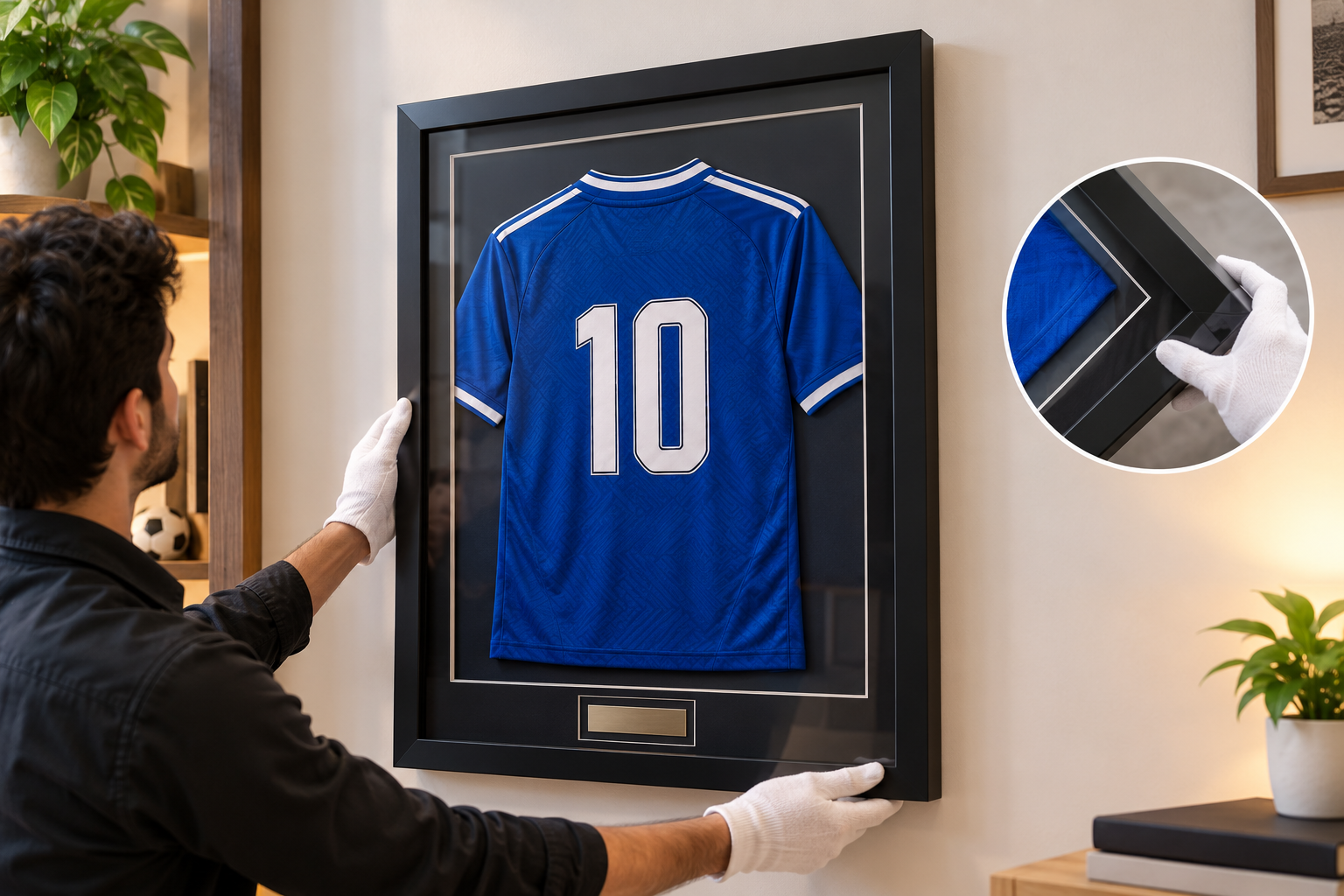
Yes. A jersey is safe in a frame when it is held with reversible mounting (stitching or pins, never glue or tape), supported by acid-free board, shielded by UV-protective glass, and given enough depth so the glass never touches the fabric. In Dubai, where sunlight is strong and rooms swing between heat and air conditioning, hanging position matters as much as the frame. Done properly, Jersey/T Shirt framing in Dubai protects the shirt rather than harming it.
You have a jersey that means something. Maybe it is a shirt signed by a player you grew up watching, the kit you wore when your team won, or a cricket jersey from a match you attended in Dubai. You want it on your wall, but you do not want to be the person who ruined it. So the question is fair: can you frame a sports jersey without damaging it?
Yes, you can. Damage almost never comes from the frame itself. It comes from shortcuts: glue, tape, cheap backing board, glass pressed against the fabric, or a sunny wall. This guide walks through every way a jersey can be harmed, what a careful framer does to prevent it, and what to check before you trust anyone with your shirt. Whether you are planning jersey framing for a collector’s piece or T shirt framing for a favourite tee, the same principles apply.
Eight Ways a Jersey Gets Damaged, and How Careful Framing Prevents Each
Instead of guessing, it helps to know exactly what can go wrong. This table is the quickest way to judge whether a framer, or a DIY kit, is really protecting your shirt.
|
Risk |
What causes it |
How it is prevented |
|
Adhesive damage |
Glue, double-sided tape or spray mount leaves residue and stains that cannot be removed. |
Archival stitching or pins hold the shirt without any adhesive, so it can be taken out again. |
|
Acid staining |
Ordinary cardboard or MDF releases acids that yellow and weaken fabric over time. |
Acid-free mount boards and backing sit directly behind the shirt. |
|
Sun fading |
Ultraviolet light bleaches colours and can fade ink on signatures. |
UV-protective glass or acrylic filters most of the harmful light. |
|
Compression |
Glass pressing on the fabric flattens fibres, crushes badges and can transfer marks. |
A deep frame or spacer keeps a gap between the shirt and the glazing. |
|
Heat damage |
A hot iron can scorch polyester and melt or lift heat-pressed numbers and logos. |
Low-heat steaming or gentle pressing with a cloth, avoiding printed areas. |
|
Moisture and mould |
Trapped humidity encourages mildew and odours behind the glass. |
A dry shirt, a sealed back, and a hanging spot away from damp walls. |
|
Sagging and stretching |
The weight of the fabric pulls on a few pin points and distorts the shape. |
Support is spread across the shirt, with stitches or pins placed along strong seams. |
|
Permanent holes |
Pushing pins or staples through the fabric leaves marks, especially on delicate material. |
Pins are placed through hems or alongside the fabric, and stitches are kept small and hidden. |
A useful rule of thumb is that any method you cannot undo is a method to avoid. If a framer tells you the jersey is glued or dry-mounted, walk away.
How to Frame a Jersey Safely: The Step-by-Step Method
1. Check the condition first. Look for loose threads, weak seams, stains and flaking prints. Tell your framer about anything fragile before work starts.
2. Decide about washing. A shirt that is clean and dry is best. If it must be washed, use cool water and a gentle cycle, and air-dry it flat. Do not wash a signed or vintage shirt, because moisture can lift ink and weaken old fabric.
3. Handle with clean, dry hands. Skin oils transfer to fabric, and sharp rings or watches can snag it.
4. Smooth out wrinkles gently. Use low heat or a steamer, never a hot iron on a printed badge, number or signature.
5. Mount by stitch or pin. Archival stitching or stainless-steel pins fix the shirt to acid-free board, so the name, number and crest show without any adhesive.
6. Give it depth. A shadow box or spacer keeps the fabric off the glass. As a rough guide, shadow boxes for jerseys are commonly at least 3 cm deep, and larger layouts go deeper.
7. Choose UV protection. UV-protective glass or acrylic slows fading. Conservation-grade glass is rated to block around 99 per cent of UV light.
8. Seal the back. A sealed, dust-proof backing keeps out dust, insects and moisture.
Why Dubai Needs Extra Care
Good jersey framing in Dubai has to account for the local climate, because every city has its own risks and Dubai’s are specific. Strong, long-lasting sunlight is the biggest. Even a bright room with indirect light can fade a shirt slowly, which is why UV protection is not an optional extra here. Then there is temperature and humidity: coastal humidity in summer, followed by cold air conditioning indoors, can encourage moisture inside a badly sealed frame. Finally, heat inside a parked car is harsh on fabric, so avoid leaving a jersey in a vehicle on the way to or from a framer.
• Hang the frame on an interior wall, away from windows and direct sun.
• Avoid placing it directly above or opposite an air-conditioning vent.
• Keep it out of bathrooms, kitchens and damp balconies.
• Dust the glass with a soft dry cloth, and never spray cleaner onto the frame.
T-Shirt Framing vs Jersey Framing: What Changes for the Shirt?
The goal is the same, but the shirt is not. T shirt framing in Dubai often involves cotton tees from concerts, marathons or school events, while jerseys are usually polyester with stitched or heat-pressed names, numbers and crests. That leads to different priorities:
• Cotton T-shirts are soft and thin. They need gentle smoothing and can sit in a shallower frame, but screen-printed graphics must never be ironed directly.
• Polyester jerseys are slippery, and they can scorch under heat. They need careful support so they do not slide or sag.
• Heat-pressed numbers and logos can lift if heated again, so treat them as the most delicate part of the shirt.
• Thick items such as padded or long-sleeved kits need a deeper box than a flat tee.
Signed, Game-Worn and Vintage: Take Extra Precautions
If the shirt has real value, whether financial or emotional, upgrade the protection rather than the decoration.
• Signed jerseys: keep the glass clear of the ink, use UV glass, and tell the framer exactly where the signature is.
• Game-worn shirts: do not wash away the history. Mount them as they are, with support at the seams.
• Vintage kits: old fabric is fragile. Ask for museum-grade glass and fully reversible mounting.
• Anything irreplaceable: ask for a written description of the materials and methods used.
DIY Jersey Framing: Where It Usually Goes Wrong
Ready-made jersey frames are sold across the UAE, and professional jersey framing in Dubai is the safer route for anything valuable. Ready-made frames can still be a fine solution for a cheap replica shirt. The trouble starts when people use them for something precious. Common mistakes include using tape or glue to hold the shirt in place, folding it so tightly that creases set, pressing it behind glass with no gap, skipping UV protection, and using backing board that is not acid-free. If the shirt matters, the cost of a professional job, which in Dubai starts from around AED 250 for simple jersey framing, is small compared with the cost of replacing it.
Red Flags When Choosing a Framer for Jersey/T Shirt Framing in Dubai
• They suggest glue, spray adhesive, tape or dry mounting.
• They cannot tell you what the backing board is made of.
• They offer only standard glass for a signed or valuable shirt.
• They will not explain how the shirt is held in place.
• There is no depth between the shirt and the glass.
Five questions worth asking before you book:
1. Is the mounting fully reversible?
2. Are the mount boards and backing acid-free?
3. Which glass do you use, and does it block UV?
4. How much space will there be between the shirt and the glass?
5. Can I see a recent jersey you have framed?
Sending Your Jersey by Mail: How to Pack It Safely
If you live in Abu Dhabi, Sharjah or another emirate, a mail-in service saves you from driving across the UAE with something precious. With Pickframes, you choose your jersey type, pick your frame, and receive a secure mailer to send the shirt to the studio. You can start your jersey framing here. To keep it safe in transit:
• Make sure the shirt is clean and completely dry before packing.
• Fold it loosely along natural seams, and avoid sharp creases through prints or signatures.
• Wrap it in acid-free tissue or a clean cotton cloth rather than plastic that can trap moisture.
• Use the secure mailer provided, and photograph the shirt first, including any signatures and existing flaws.
• Do not leave the parcel in a hot car or in direct sunlight.
Already Framed? Signs Something Is Wrong
If your jersey is already on the wall, check it every few months. Warning signs include faded colours compared with the unexposed areas, yellowing or brown marks, a musty smell, condensation on the inside of the glass, fabric touching the glass, and a shirt that has slipped or sagged. If you notice any of these, take the frame down and ask a framer to inspect it before the damage spreads.
Frequently Asked Questions About Framing a Jersey Without Damage
1. Can I frame my favorite sports jersey without damaging it?
Yes. A jersey stays safe when it is mounted with reversible stitching or pins, backed by acid-free board, protected by UV-protective glass, and kept slightly away from the glass by a shadow box or spacer. Damage usually comes from glue, tape, acidic backing, heat or direct sunlight, not from framing itself.
2. Can a framed jersey be taken out of the frame later?
Yes, as long as it was mounted with reversible methods. Archival stitching or pin mounting can be removed without leaving adhesive residue, so the shirt can be worn, cleaned or reframed later. If a framer uses glue, tape or dry mounting, the shirt may be permanently marked, so ask about reversibility before you book.
3. Should I wash or iron my jersey before framing it?
A clean, dry shirt is best, but avoid washing signed or vintage jerseys, because water can lift ink and weaken old fabric. If you need to remove wrinkles, use low heat or a steamer, and never iron directly over printed numbers, logos or signatures. A professional framer can smooth the shirt safely for you.
4. Does UV glass really protect a jersey in Dubai?
It helps a great deal. UV-protective glass filters most ultraviolet light, the main cause of fading, and conservation-grade glass is rated to block around 99 per cent. It does not make a shirt immune, so also hang the frame away from windows and direct sun, which is especially important in Dubai’s strong light.
5. Is T-shirt framing in Dubai different from jersey framing?
The safety rules are the same: reversible mounting, acid-free materials, UV glass and no glass contact. The differences are practical. Cotton T-shirts are thinner and may fit a shallower frame, while polyester jerseys need careful support and have heat-pressed numbers that must not be ironed. A good framer adjusts the method to the fabric.
Your jersey does not have to stay folded in a drawer to stay safe. With reversible mounting, acid-free materials, UV protection and a sensible spot on the wall, framing actually protects it. Choose a framer who can explain every step, ask the questions above, and treat anything irreversible as a red flag. Whether you want Jersey Framing in Dubai for a signed collector’s piece or T shirt framing in Dubai for a favourite tee, the right method lets you enjoy it every day without worry.