
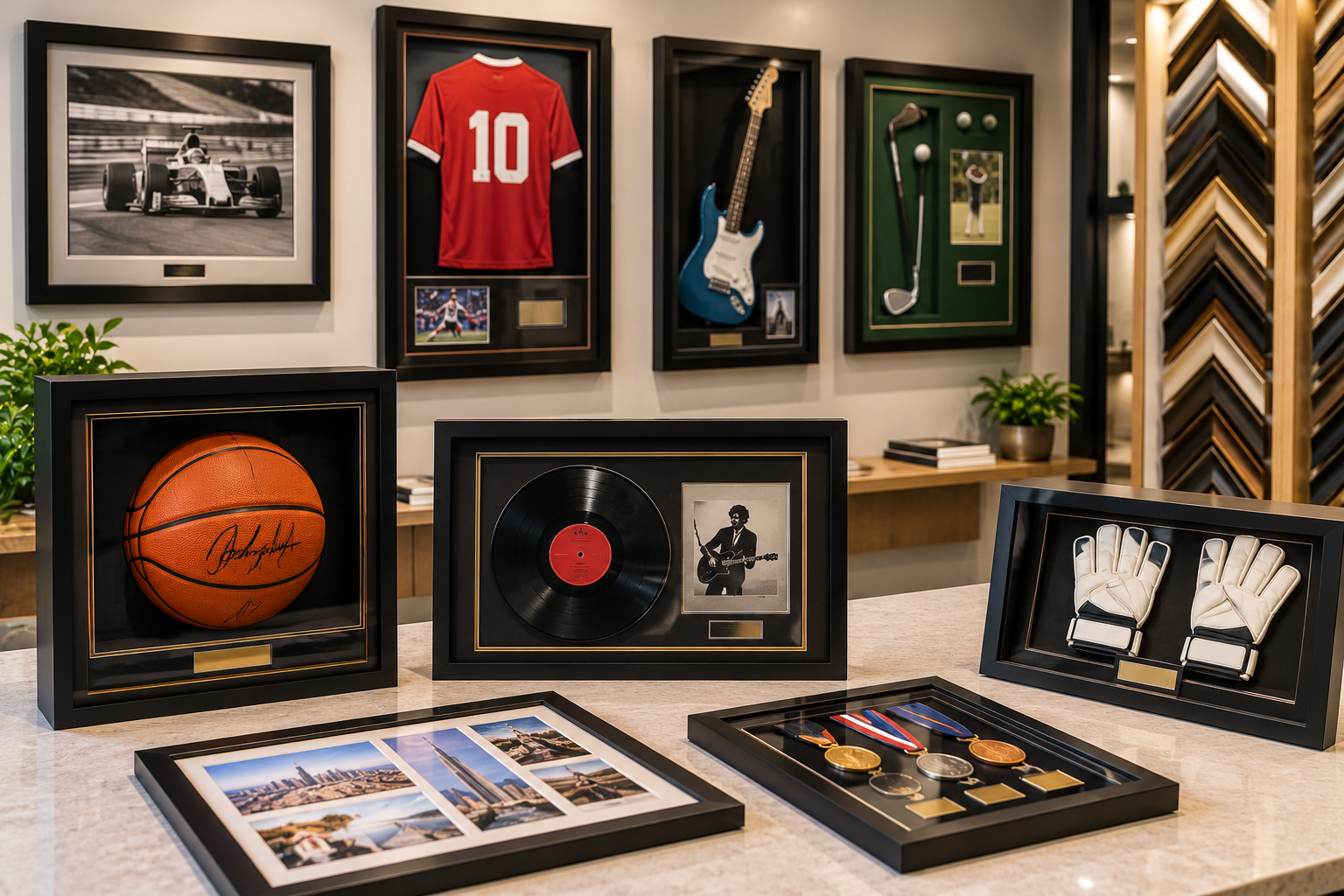
Yes. Framing shops can frame a wide range of memorabilia besides jerseys, including tickets, medals, caps, posters, programmes, photographs, signed items, certificates, badges, baby keepsakes and small objects. Flat items go in standard frames, while three-dimensional items need a shadow box with enough depth, commonly around 5 to 7 cm in Dubai. Good framers use reversible, archival mounting, acid-free materials and UV-protective glass. Published Dubai pricing shows jersey and memorabilia framing from around AED 250 and shadow box framing from around AED 300, with custom designs quoted per project.
Most people first think of a framing shop when they have a picture or a certificate. Jerseys are the next obvious step. But look around your home, your office or your storage box, and you will probably find other things worth keeping on a wall: a match ticket, a signed cap, a medal, a concert poster, a child’s first shoes, a wedding invitation, a military badge.
So can a framing shop frame memorabilia besides jerseys? In most cases, yes. This guide walks through the most common types of memorabilia, how each is usually mounted, what to watch out for, how to combine several items in one display, and what to ask your framer. It is written for anyone considering Custom Framing in Dubai, including Jersey/T Shirt framing in Dubai and other keepsakes.
What Counts as Memorabilia?
Memorabilia is anything you keep because it reminds you of a person, event or achievement. It does not have to be valuable in money terms. Many of the best framed pieces are valuable because of the story behind them.
The most common categories are:
• Sports: jerseys, caps, boots, gloves, balls, medals, tickets and programmes.
• Entertainment: concert tickets, signed posters, vinyl records, wristbands and backstage passes.
• Personal milestones: wedding invitations, graduation certificates, baby shoes and hospital bracelets.
• Travel and heritage: maps, postcards, passports pages, coins and stamps.
• Work and service: badges, patches, awards, name plates and uniforms.
• Collectables: trading cards, signed photographs, comics and film props.
If you can lay it on a table, there is a good chance it can be framed.
Flat Memorabilia vs Three-Dimensional Memorabilia
The first question a framer will ask is whether the item is flat or has depth. It decides the type of frame.
|
Type |
Examples |
Usual frame |
|
Flat |
Tickets, posters, photographs, certificates, programmes, letters |
Standard frame with mount, or a shallow box |
|
Slightly raised |
Medals on ribbons, badges, patches, coins, wristbands |
Shadow box with a shallow depth |
|
Fabric |
Jerseys, T-shirts, scarves, flags, uniforms |
Shadow box, depth chosen by thickness |
|
Three-dimensional |
Caps, boots, balls, helmets, trophies, baby shoes |
Deep shadow box with supports |
|
Mixed |
A shirt with a ticket, photo and medal |
Custom shadow box and layout |
Published Dubai specifications show shadow boxes of around 5 to 7 cm deep, and deeper custom boxes are possible for larger items.
Memorabilia You Can Frame, and How It Is Usually Done
Tickets, Programmes and Paper Items
Paper is light, but it is also sensitive to acid, light and moisture. A good framer will mount tickets and programmes on acid-free board using archival corners or hinges, instead of glue or tape. Thermal paper, such as many modern match tickets, fades quickly in light, so UV-protective glass is especially worthwhile.
Posters and Signed Prints
Large flat pieces usually go in a standard frame with a mount, so the paper does not touch the glass. Signed posters should be kept out of direct sunlight, and framed with UV-protective glazing, since ink can fade.
Medals, Badges and Patches
Medals and ribbons need a shadow box so that they can sit naturally, often on a fabric backing in a team or neutral colour. A framer can secure them with stitching or concealed fixings, which keeps them in place without glue.
Caps, Helmets and Hats
Caps need depth and support, so they hold their shape. Framers often use a padded form or a shelf inside a deep box, and pair the cap with a ticket or photo.
Balls, Boots and Gloves
These need the deepest boxes and strong supports. A framer will fix them to a backing board or shelf so the weight is carried properly, and will avoid pressure on signatures or printed areas.
Baby Keepsakes
Tiny shoes, hospital bracelets, a first outfit and a birth certificate are among the most popular keepsakes. They are small and soft, so a gentle layout, acid-free materials and a clear frame work well. A name plate and a date turn them into a family record.
Wedding and Family Memorabilia
Invitations, a dried bouquet, a veil edge, a guest book page or a pair of rings in a presentation setting can all be framed. Fragile items such as dried flowers need depth and careful handling, and may fade, so UV protection is important.
Coins, Stamps and Collectables
Coins and stamps are usually mounted on a mat with cut-outs, or on a backing with small retainers. Because they can be valuable, ask the framer about reversible mounting and whether the item should be handled with gloves.
Uniforms, Flags and Textiles
Fabric items such as a school blazer, scout scarf, flag or military uniform part are treated like jerseys. They are held with archival stitching or pins on acid-free backing, with enough depth to keep the glass off the cloth.
Combining Several Items in One Display
A single item is nice. Several items telling one story are better. A shirt, a ticket, a photograph and a medal from the same match, for example, make a complete record of a day.
• Choose one hero. Make one item the focus, and let the others support it.
• Keep a theme. Use one event, person or season for each display.
• Mind the balance. Space items evenly, and avoid cramming.
• Add context. A small plaque with the date, place and names finishes the piece.
• Plan depth for the tallest item, and make sure the lighter items are still supported.
Our guide on custom display boxes for jerseys explains how framers design these combinations.
Protecting Memorabilia in a Sunny City
Different materials fade and age at different rates, but a few rules apply to nearly everything.
• Use UV-protective glass or acrylic. Some brands rate their conservation glass at around 99 per cent UV blocking, which is useful in Dubai.
• Choose acid-free backing and mounts so nothing stains or yellows.
• Use reversible mounting, with no glue, tape or adhesives touching the item.
• Keep the glass off the item, with a mount or spacer.
• Hang it away from windows, heat, damp and air-conditioning vents.
Mixed displays are only as safe as the most delicate item in them, so protect for the weakest piece.
What Framers Usually Will Not or Cannot Do
Not everything is suitable for framing, and a good framer will say so.
• Items that are damp, mouldy or fragile may need conservation or restoration first.
• Items that are very heavy or sharp may need special fixings, or may not fit a standard box.
• Food, liquids or perishable items are not suitable.
• Items with legal or safety restrictions, such as certain weapons or hazardous materials, will be refused.
• Very valuable or historic items may need a specialist conservator.
When in doubt, describe the item to the framer, send photographs and ask what is possible before you send it.
How the Process Works
1. List and photograph the items, and note sizes and any signatures.
2. Choose a layout and theme. Decide which item is the hero.
3. Pick the frame, depth and glass. Prioritise protection for valuable or fragile items.
4. Get an itemised quote and a timeline.
5. Send or deliver the items, packed safely.
6. Approve any design details, such as the plaque text.
7. Receive your display, and hang it with proper fixings.
Published timelines from one Dubai framer show a typical jersey frame taking around 3 to 5 working days, with museum-grade work taking around 5 to 7 days. Mixed displays may take longer.
How Much Does Memorabilia Framing Cost?
Prices depend on size, depth, glass, mounting and the number of items. Published Dubai pricing shows jersey and memorabilia framing from around AED 250 and shadow box framing from around AED 300. Larger boxes, UV or conservation glass, multiple items and engraved plaques cost more, and are normally quoted per project. Ask for an itemised quote so you can see where the money goes.
What About Jerseys and T-Shirts?
Fabric is the most popular type of memorabilia, so most framers are used to it. Jersey Framing and T Shirt framing follow the same principles as other memorabilia: reversible mounting, acid-free materials, UV protection and enough depth. If you are arranging Jersey Framing in Dubai or T shirt framing in Dubai, you can add a ticket, a medal or a photo to the display to tell the whole story, and the framer will design the box around them.
Ordering With Pickframes
With Pickframes, you choose your jersey type, pick a frame in a wide range of colours and see the price upfront before you order. If you live in Dubai, Abu Dhabi, Sharjah or elsewhere in the UAE, a secure mailer is sent so you can send your shirt to the studio, and the estimated delivery is shown at checkout. You can start your jersey framing here or browse textiles framing. If you have other memorabilia you want to add, contact the team before you order to ask what is possible.
Questions to Ask a Framer About Memorabilia
• Do you frame this type of item, and have you done it before?
• How will it be mounted, and is it reversible?
• How deep should the box be?
• What glass do you recommend, and what UV protection does it give?
• Can you add a plaque, photo or ticket to the display?
• What does the quote include, and how long will it take?
• How will you handle and return my items safely?
Frequently Asked Questions About Framing Memorabilia
1. Can I frame memorabilia besides jerseys at framing shops?
Yes. Framing shops can frame many types of memorabilia, including tickets, medals, caps, posters, programmes, photographs, certificates, badges, baby keepsakes and small objects. Flat items go in standard frames, while three-dimensional items need a deeper shadow box. Ask the framer whether they handle your specific item.
2. What is the best frame for three-dimensional memorabilia?
A shadow box is best, because it has a gap between the glass and the backing so objects are not pressed flat. Published Dubai specifications show depths of around 5 to 7 cm, and deeper custom boxes can be made for balls, boots and helmets. Heavy items need supports and proper fixing.
3. Can I combine a jersey with other memorabilia in one frame?
Usually yes. Many people display a jersey with a ticket, medal, photograph and plaque in a custom shadow box. A framer will plan the depth, layout and mounting so every item is supported and protected. Choose one hero item and keep a single theme for the best result.
4. How much does memorabilia framing cost in Dubai?
Published Dubai pricing shows jersey and memorabilia framing from around AED 250 and shadow box framing from around AED 300, based on one framer’s price list. Larger boxes, UV glass, multiple items and plaques cost more and are normally quoted per project. Ask for an itemised quote.
5. Does T-shirt framing in Dubai work the same as other memorabilia framing?
Largely, yes. T-shirt framing uses the same principles: reversible archival mounting, acid-free materials, UV-protective glass and enough depth. A T-shirt can also be combined with tickets, wristbands or photos in a custom box for a fuller story.
Memorabilia is the story of your life in objects, and a good frame turns it into something you can see every day. Frame what matters to you, ask for reversible mounting and UV protection, give three-dimensional items the depth they need, and keep each display to one clear theme. Whether you are planning Jersey/T Shirt framing in Dubai or other Custom Framing in Dubai for tickets, medals and keepsakes, a framer who listens will help you protect the memories as well as show them.