
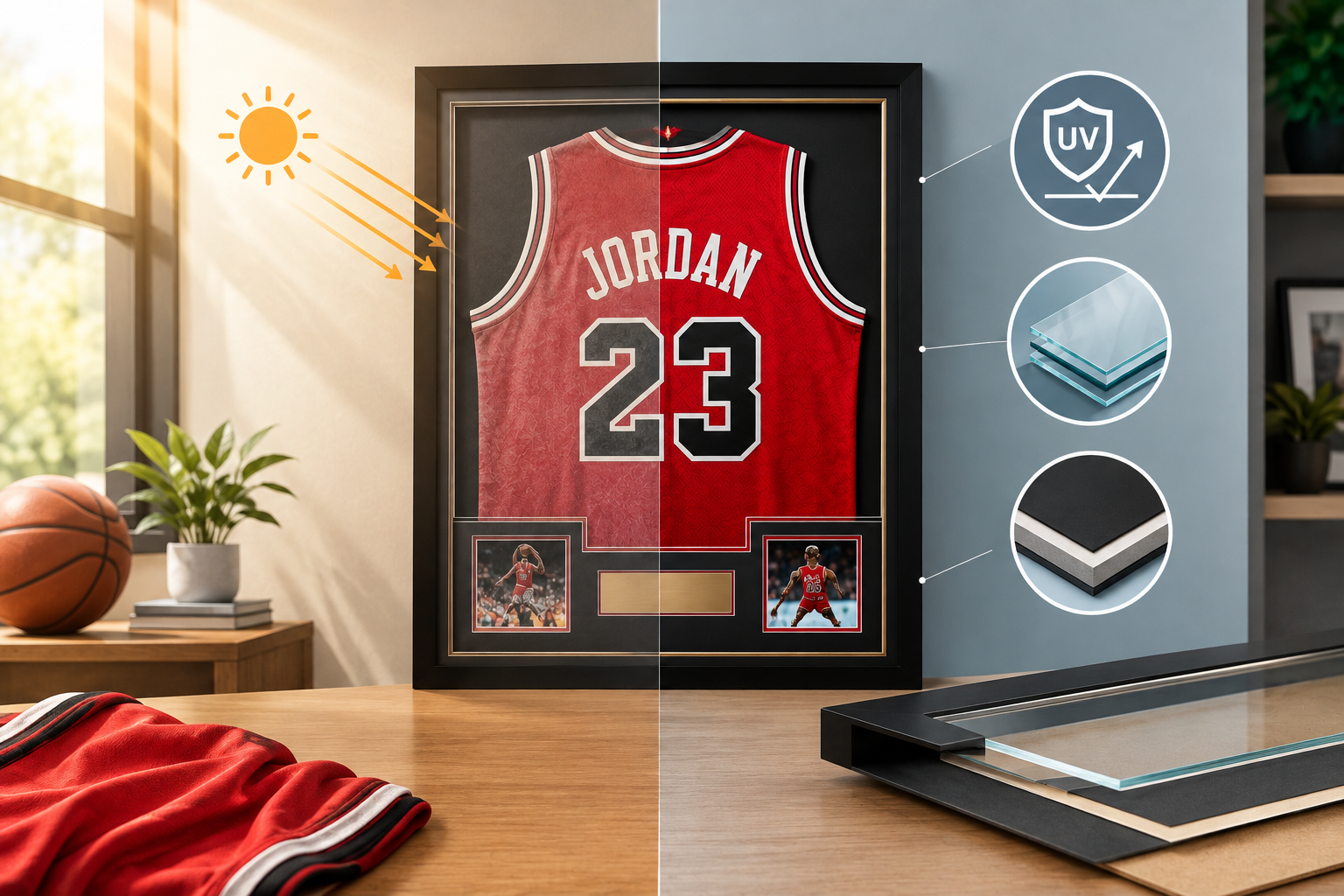
Yes, custom framing can significantly slow fading, mainly through UV-protective glass or acrylic, acid-free materials, a sealed back and enough depth to keep the shirt off the glass. Conservation-grade glass is rated by some brands to block around 99 per cent of UV light. But framing cannot stop fading entirely, because visible light, heat and humidity also play a part. Hanging the frame on an interior wall, away from direct sun, matters as much as the glass. In Dubai, jersey framing starts from around AED 250, with UV protection a sensible default.
Anyone who has left a favourite shirt on a sunny balcony knows what light can do. The deep red turns a tired pink, the white yellows, and the crisp print goes dull. Now imagine that happening slowly to a signed jersey on your living-room wall.
So the question is a fair one: does custom framing actually stop a jersey from fading, or is that just a sales line? The honest answer has two halves. Framing done properly can slow fading dramatically, but no frame can stop it completely, and the wrong choices can make things worse. This guide separates myth from fact, explains what causes fading, and shows which materials and habits make the biggest difference, with a focus on Jersey/T Shirt framing in Dubai, where the sun is among the strongest challenges.
What Actually Makes a Jersey Fade?
Fading is a chemical process, and several things drive it at once. Understanding them is the key to protecting a shirt.
|
Cause |
What it does |
How framing helps |
|
Ultraviolet (UV) light |
Breaks down dyes and fibres, and fades ink, including signatures |
UV-protective glass or acrylic filters most UV |
|
Visible light |
Also contributes to fading over time, especially from strong or close lighting |
Placement and softer lighting reduce exposure; glass alone does not remove it |
|
Heat |
Speeds up chemical reactions and can stress prints and fibres |
Hanging away from sun and heat sources |
|
Humidity and moisture |
Encourages mildew, staining and weakening of fibres |
A sealed back and a dry hanging spot |
|
Acids and chemicals |
Cause yellowing and brittleness in nearby materials |
Acid-free mounts, backing and spacers |
|
Dust and pollution |
Dull colours and trap moisture against fabric |
A dust-proof sealed frame |
Notice that only some of these are about light. This is why a frame with excellent glass can still age badly if it hangs in a humid room or uses acidic backing.
Myth vs Fact
• Myth: “A frame stops fading.” Fact: it slows fading. Protection reduces exposure but never removes it.
• Myth: “Any glass blocks UV.” Fact: standard glass filters little UV. UV-protective glass or acrylic is designed to filter most of it.
• Myth: “If it is behind glass, it is safe in a sunny room.” Fact: strong light still reaches the shirt, and direct sun can damage even protected pieces over time.
• Myth: “Fading only affects the fabric.” Fact: signature ink and printed numbers can fade too, sometimes faster than the shirt.
• Myth: “Darker colours do not fade.” Fact: all dyes can fade. Some bright reds and certain blues are often more sensitive, but any colour can change.
• Myth: “Cheap frames are fine because the shirt is not in the sun.” Fact: indirect light, acids and humidity all play a part, even on an interior wall.
The Protection Stack: What Slows Fading
Protection is not one feature. It is a combination, and the layers work together.
1. UV-protective glazing. The single biggest upgrade. UV-protective glass or acrylic filters most ultraviolet light, and conservation-grade glass is rated by some brands to block around 99 per cent.
2. Acid-free mounts and backing. These stop chemical damage from the materials themselves.
3. Depth. A shadow box keeps the fabric off the glass, which prevents contact marks and gives some separation from heat at the glass surface.
4. A sealed, dust-proof back. It keeps out dust, insects and moisture.
5. Reversible mounting. Archival stitching or pins avoid adhesives that discolour or stain over time.
6. Sensible placement. The frame on an interior wall, away from windows and heat, protects it more than any single material.
Glass Options Compared for Fade Protection
|
Glazing |
Fade protection |
Best for |
|
Standard glass |
Minimal UV filtering |
Low-value shirts in dim rooms |
|
UV-protective glass or acrylic |
Filters most ultraviolet light |
Most jerseys; a sensible Dubai default |
|
Conservation or museum-grade glass |
Highest UV filtering, rated by some brands at around 99 per cent, often with low reflection |
Signed, game-worn, vintage or valuable pieces |
|
Anti-reflective glass |
Cuts glare; check the UV rating separately |
Bright rooms where visibility matters |
Dubai framers publish partnerships with specialist glass brands such as Tru Vue and Groglass. Whatever the brand, ask for the exact product name and its UV rating, and do not assume that “anti-reflective” means “UV-protective”. They are different features, and some products combine both.
Why Dubai Makes Fading a Bigger Risk
The UAE’s sunshine is intense for much of the year, and bright, glass-heavy buildings flood rooms with light. Three local factors matter for jersey framing in Dubai:
• Strong, long-lasting sunlight. Even indirect daylight in a south- or west-facing room adds up over months and years.
• Heat. Surfaces near windows can get hot, which speeds up chemical change and stresses prints.
• Humidity and air conditioning. Coastal humidity in summer, followed by cold air indoors, can encourage moisture inside a poorly sealed frame.
This is why a framer in Dubai should treat UV protection as a standard recommendation, not an optional extra.
Where You Hang It Matters as Much as the Glass
• Choose an interior wall away from windows, balconies and glass doors.
• Avoid direct and reflected sun. A mirror or glossy surface can bounce light onto a frame.
• Use soft, cool LED lighting rather than hot spotlights close to the glass.
• Keep it clear of air-conditioning vents, where temperature swings are greatest.
• Avoid damp rooms such as bathrooms and unventilated balconies.
• Rotate or protect it on sunny days if the only available wall gets light, for example with blinds or a curtain.
What About Signed Jerseys?
A signature is often the most valuable part of the shirt, and the ink can be more fragile than the fabric. Marker inks vary, and some fade noticeably with light exposure. For a signed jersey, treat UV glass as essential rather than optional, keep the glass away from the ink with enough depth, and tell your framer exactly where the signature is. Do not retouch or “refresh” faded ink, because that can reduce authenticity and value. If you want to protect the story as well as the shirt, keep photographs and any certificate of authenticity stored safely, away from the display.
T-Shirt Framing and Fading
T shirt framing faces the same risks, with some differences. Cotton tees from concerts, marathons or events often carry screen-printed graphics, and those prints can fade or crack. Black cotton can look washed out when exposed to light. A thin shirt may also be more affected by direct heat. T shirt framing in Dubai should therefore use the same protection stack: UV glass, acid-free materials, a sealed back and a sensible hanging spot. For a rare or signed tee, upgrade to conservation-grade glass.
Signs Your Framed Jersey Is Fading or Deteriorating
• Colours look paler on the side facing a window than on the hidden side.
• Whites or cream turn yellow or brown.
• Printed numbers or logos look dull or cracked.
• Signature ink looks lighter or patchy.
• A musty smell or condensation appears inside the glass.
• The fabric touches the glass, or the shirt has slipped.
If you notice any of these, take the frame down, move it to a safer wall and ask a framer to inspect it. Early action can prevent further damage, though faded fabric cannot usually be restored.
Questions to Ask Your Framer About Fade Protection
1. Which glass or acrylic do you use, and what UV protection does it offer?
2. Are the mount boards and backing acid-free?
3. How is the shirt held, and is it fully reversible?
4. How deep is the frame, and will the shirt touch the glass?
5. Is the back sealed against dust and moisture?
6. Where would you recommend I hang it in my home?
Mail-In Framing With UV Protection
If you live in Abu Dhabi, Sharjah or elsewhere in the UAE, you can protect a jersey without carrying it across emirates. With Pickframes, you choose your jersey type, pick a frame, and receive a secure mailer to send the shirt to the studio. You can start your jersey framing here and read more about UV art glass. Before ordering, check the specification of the glass for your frame, so you know exactly what protection you are getting. Meanwhile, keep the shirt out of heat and sunlight while it waits to be framed.
Frequently Asked Questions About Framing and Fading
1. Can custom framing protect my jersey from fading?
Custom framing can significantly slow fading but cannot stop it completely. UV-protective glass or acrylic filters most ultraviolet light, acid-free materials prevent chemical damage, and a sealed back keeps out dust and moisture. Hanging the frame away from direct sun matters just as much as the glass, especially in Dubai.
2. Does UV glass really stop a jersey fading?
It helps a great deal but is not absolute protection. UV-protective glass filters most UV, and conservation-grade glass is rated by some brands to block around 99 per cent. However, visible light, heat and humidity also contribute to fading, so placement on an interior wall and a sealed frame remain important.
3. Will a framed jersey fade faster in Dubai?
It can, if hung where strong sunlight or heat reaches it. Dubai’s intense, long-lasting sun means UV protection is especially worthwhile, and an interior wall away from windows is the safest spot. Coastal humidity and air conditioning also make a sealed back and acid-free materials important.
4. Can signatures fade on a framed jersey?
Yes. Signature ink can fade with light exposure, sometimes faster than the fabric. Use UV-protective glass, keep the signature clear of the glass with a shadow box or spacer, hang the frame away from sun, and tell your framer where the signature is. Do not retouch faded ink, as it can reduce value.
5. Does T-shirt framing in Dubai need UV protection too?
Yes. Cotton tees with screen prints and black fabrics are also affected by light, and prints can fade or crack. The same protection applies: UV-protective glass, acid-free mounts, a sealed back and a sensible hanging spot. For a signed or rare T-shirt, conservation-grade glass is worth the upgrade.
Custom framing cannot freeze a jersey in time, but it can add years, and often decades, to its life. Choose UV-protective glass, insist on acid-free materials and reversible mounting, keep the shirt off the glass, and hang the frame where the sun cannot reach it. Whether you are arranging Jersey Framing for a signed collector’s piece or T shirt framing in Dubai for a tee you love, treat fade protection as the core job of the frame, and the shirt will keep looking the way you remember it.