
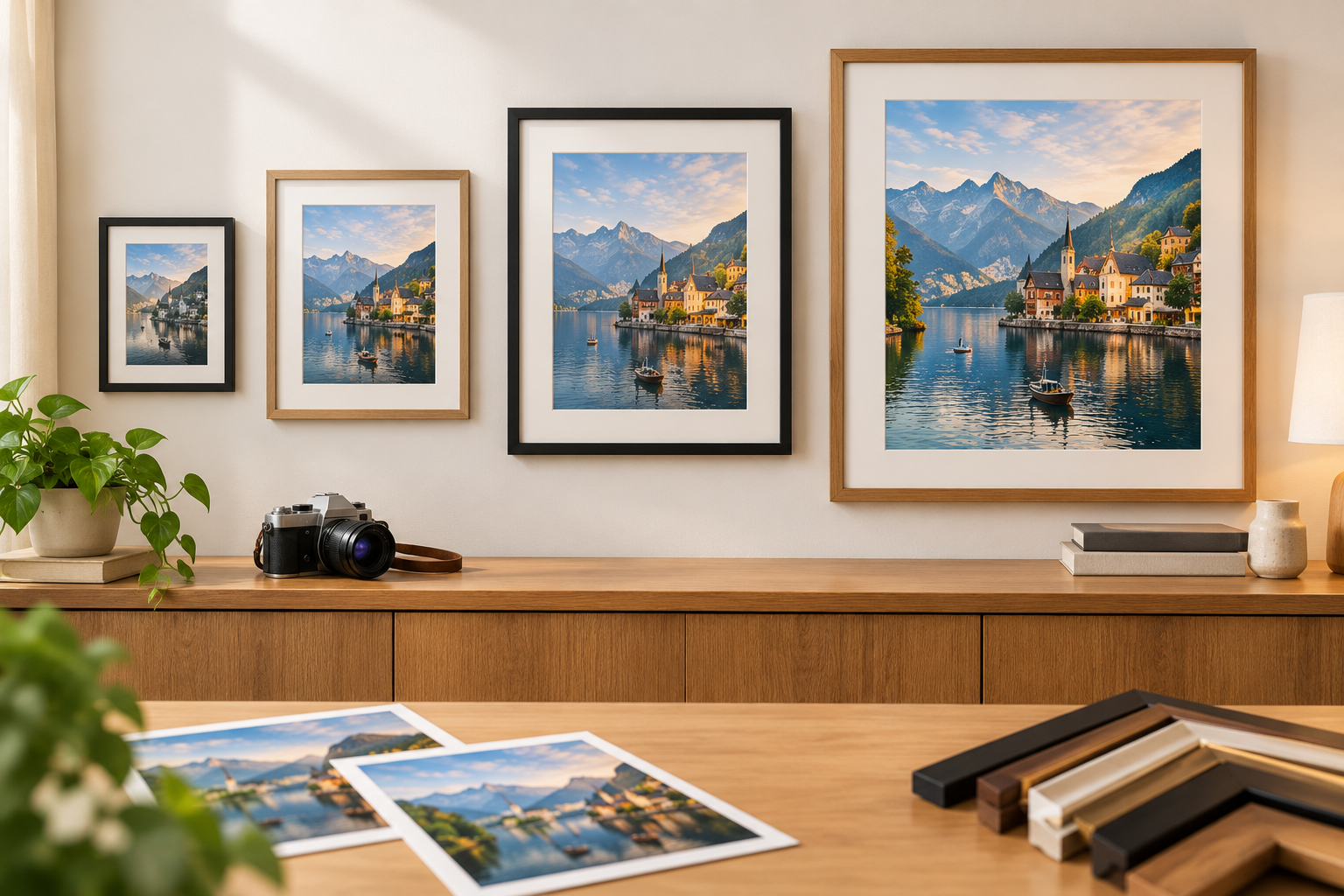
The best frame size for professional photographs depends on viewing distance and wall space: roughly 8x10 to 11x14 inches for desks and close-viewing walls, 16x20 to 20x24 for standard living room walls viewed from a few metres away, and 24x36 or larger for statement pieces viewed across an open room. Matching the frame to the photograph's native aspect ratio (3:2 for most professional cameras, 4:5 for medium format) avoids cropping. Online photo framing in Dubai allows custom sizing to the exact ratio, removing the need to crop a professional shot to fit a standard frame.
A stunning photograph in the wrong size frame reads as awkward before anyone even registers why. Too small on a large wall and it disappears. Too large in a narrow hallway and it dominates a space it was never meant to fill. Professional photography deserves a size decision made on purpose, not by whatever happened to be in stock.
Frame size isn't really about the photo alone — it's about the photo, the wall, and the distance people will actually be standing when they look at it. Get that relationship right and the size question answers itself — whether you're a photographer framing your own portfolio or choosing photo frames for a client's finished prints.
The Viewing Distance Rule of Thumb
Professional photographers and gallery curators use a simple relationship: the ideal frame size scales with how far back the average viewer will stand. A photo sized for a coffee table doesn't work stretched across a stairwell wall, and vice versa.
|
Typical Viewing Distance |
Recommended Frame Size |
|
Arm's length (desk, shelf) |
5x7 to 8x10 inches |
|
Across a room (sofa, hallway) |
11x14 to 16x20 inches |
|
Standard living room wall (2–3 metres) |
16x20 to 20x24 inches |
|
Large open space or feature wall (3+ metres) |
24x36 inches or larger |
As a rough formula: divide the expected viewing distance (in inches) by roughly 3 to 4 to estimate a comfortable frame width — a photo viewed from 10 feet (120 inches) suits something in the 30–40 inch range.
Matching Frame Size to Your Camera's Aspect Ratio
This is where a lot of professional photography gets cropped without the photographer intending it. Every camera format shoots in a specific aspect ratio, and forcing that image into a mismatched standard frame size means losing part of the composition.
|
Camera / Format |
Native Ratio |
Best-Matching Frame Sizes |
|
Most DSLR / mirrorless (35mm) |
3:2 |
4x6, 8x12, 12x18, 20x30 |
|
Medium format |
4:5 |
8x10, 16x20, 20x25 |
|
Square format / Instax |
1:1 |
8x8, 12x12, 20x20 |
|
Panoramic / wide crops |
16:9 or wider |
Custom sizing recommended |
Standard retail frames are almost always cut for the 4:5 ratio (8x10, 16x20), which is why 3:2 images from most professional cameras get cropped by default unless you specifically size the frame to match.
Sizing by Purpose
• Professional headshots and portfolio prints — 8x10 or 11x14, easy to display on a desk or in a professional gallery wall
• Wedding and event photography — 16x20 for a single hero image, or a collage frame for a curated set from the day
• Gallery or exhibition submissions — check the specific venue's size requirements first; many galleries have fixed size brackets
• Client gifts and delivered prints — 8x10 to 11x14 is the most universally practical size for a client's home
• Studio or office display walls — 20x24 and larger for a statement piece that anchors the room
Whatever the purpose, sizing consistently across a set — say, every client gift or every portfolio print at the same dimensions — also makes future reordering and framing simpler down the line, since you're not solving the same sizing question from scratch each time.
Print Resolution: The Size Limit Your Camera Actually Sets
There's a ceiling on frame size that has nothing to do with walls or ratios: your file's resolution. Printing beyond a photo's effective resolution results in a soft, pixelated enlargement no frame can disguise. As a practical benchmark, aim for at least 150–300 DPI (dots per inch) at your chosen print size — a 24-megapixel file comfortably supports a 16x20 print at full quality, while pushing the same file to 30x40 starts to strain it.
If you're unsure whether a specific professional shot can support a larger frame size, it's worth checking the file's pixel dimensions against your intended print size before ordering custom framing, rather than discovering the limit after the piece is already hanging.
Portrait vs. Landscape: Getting Orientation Right
Orientation matters as much as raw dimensions. A portrait-oriented photograph forced into a landscape frame (or the reverse) either gets cropped or surrounded by excessive matting on two sides. A few quick rules:
• Full-length portraits and architectural verticals suit tall, narrow portrait frames
• Landscape photography, group shots, and wide scenes suit horizontal frames
• Square-format shots are orientation-neutral, which is part of why they've become popular for gallery walls
• When mixing orientations on one wall, anchor the layout around your largest piece and build outward
Common Sizing Mistakes to Avoid
• Cropping a professional shot to force it into a standard retail frame size instead of using custom sizing
• Choosing frame size based on the wall alone, without considering typical viewing distance
• Ignoring matting width, which effectively changes the visual size of the piece even at a fixed frame dimension
• Mixing too many odd sizes on one gallery wall without a unifying layout plan
Why Custom Sizing Matters More for Professional Photography
Professional photography is composed deliberately — the crop, the framing within the shot, the negative space are all intentional choices made before the shutter even clicks. Squeezing that composition into the nearest standard frame size undoes part of that work. Online custom framing lets you specify the frame to the photograph's actual ratio and intended size, rather than the reverse.
Pickframes offers online photo framing in Dubai built around exact measurements, so a 3:2 professional shot doesn't need to lose part of its composition just to fit a 4:5 frame that happened to be on the shelf. The same online framing process supports oversized statement prints, panoramic crops, and standard sizes equally, with delivery across Dubai and the UAE.
1. Decide on viewing distance and wall space first
2. Check your photograph's native aspect ratio before choosing a size
3. Use custom framing sizing to match that ratio exactly, avoiding unwanted cropping
4. Select matting width — wider mats effectively increase the piece's visual footprint on the wall
5. Confirm the price and order your online photo frames for delivery
Frequently Asked Questions
What is the most popular frame size for professional photographs?
16x20 inches is one of the most common sizes for a single statement photograph on a standard living room wall, while 8x10 and 11x14 are the most practical for desks, portfolios, and client gifts.
How do I know what frame size fits my wall?
As a general rule, divide the expected viewing distance in inches by roughly 3 to 4 to estimate a comfortable frame width. A photo viewed from across a standard living room typically suits 16x20 to 20x24.
Why does my photo get cropped when I put it in a standard frame?
Most professional cameras shoot in a 3:2 ratio, while standard retail frames (8x10, 16x20) are cut for a 4:5 ratio. Custom framing sized to the photo's actual ratio avoids this mismatch entirely.
Is custom sizing available through online photo framing in Dubai?
Yes. Online custom framing lets you enter your photograph's exact dimensions or aspect ratio, so professional shots in 3:2, panoramic, or other non-standard ratios can be framed without cropping.
What size frame works best for a professional portfolio wall?
8x10 or 11x14 frames are the most practical and versatile for portfolio displays, offering enough presence without overwhelming a shared gallery-style layout of multiple images.
The best frame size isn't a single universal number — it's a relationship between the photograph's own composition, the wall it's going on, and how far back people will actually stand to view it. Work out those three factors first, and online custom framing takes care of the rest, matching the frame to the photo instead of the other way around.